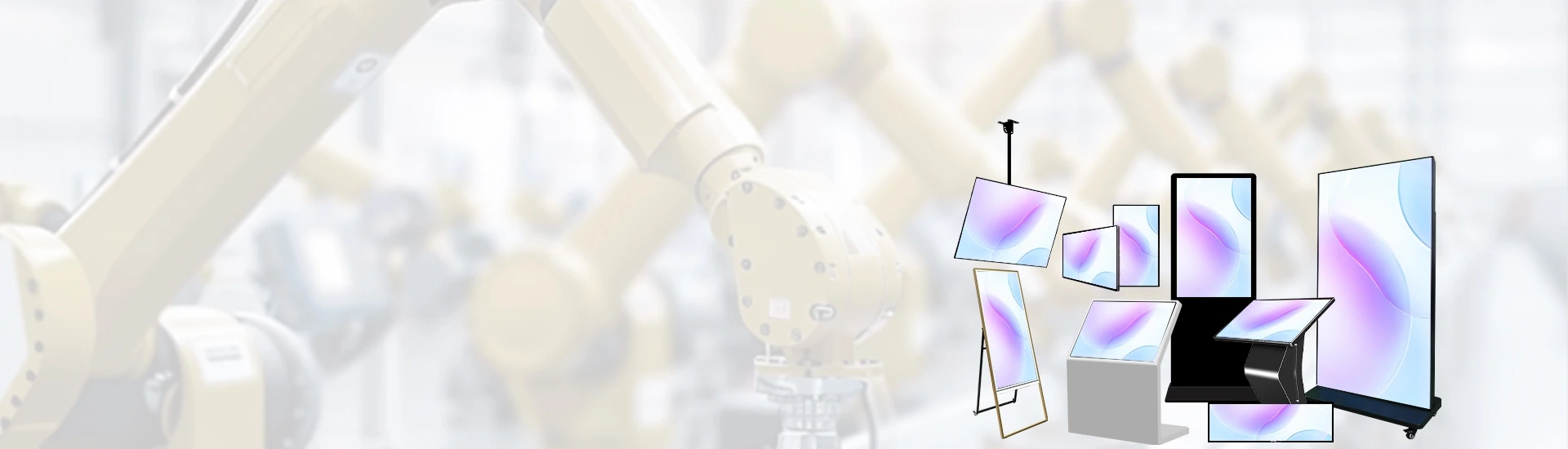
Fine dining brands are no longer treating digital display hardware as an optional upgrade — it is becoming standard infrastructure for guest experience and brand consistency. The global digital signage market was valued at roughly USD 23.7 billion in 2025 and is projected to keep growing at close to an 8.6% CAGR, with the restaurant and quick-service segment alone expected to expand from about USD 3.3 billion toward USD 12.78 billion by 2034, driven largely by dynamic digital menu boards and self-service ordering hardware.
For fine dining brands, the guest experience is built from atmosphere, visual presentation, menu interaction, and brand storytelling — not food alone. Traditional printed menus and static signage have real, measurable limitations: they cannot showcase premium dishes in motion, they leave little room for ingredient stories, and updating them for seasonal menus or promotions is slow and costly. Commercial display hardware, from a floor standing digital signage unit at the entrance to a compact บอร์ดเมนูดิจิทัล at the bar, closes both gaps at once.
Digital display hardware gives brands a visual channel that printed material simply cannot match — full-motion dish photography, rotating seasonal campaigns, and chef or ingredient storytelling that updates in minutes rather than requiring a reprint. Industry benchmarking shows digital displays capture significantly more visual attention than static signage, which is exactly the kind of attention fine dining brands want directed at a signature dish or a limited seasonal menu.
Going digital doesn't mean removing staff from the guest interaction — it means freeing them from repetitive tasks. A well-placed commercial display or self-service ordering kiosk can explain menu details, introduce wine selections, and surface promotions on its own, so staff can spend that time on higher-value, face-to-face service.
Restaurant groups and franchises typically struggle with three things: stores running different menu formats, slow rollout of new product launches, and inconsistent brand visuals. A standardized fleet of commercial display panels, managed centrally through a CMS, lets headquarters push brand content, seasonal campaigns, and menu updates to every location — down to the store-level hardware — from one dashboard.
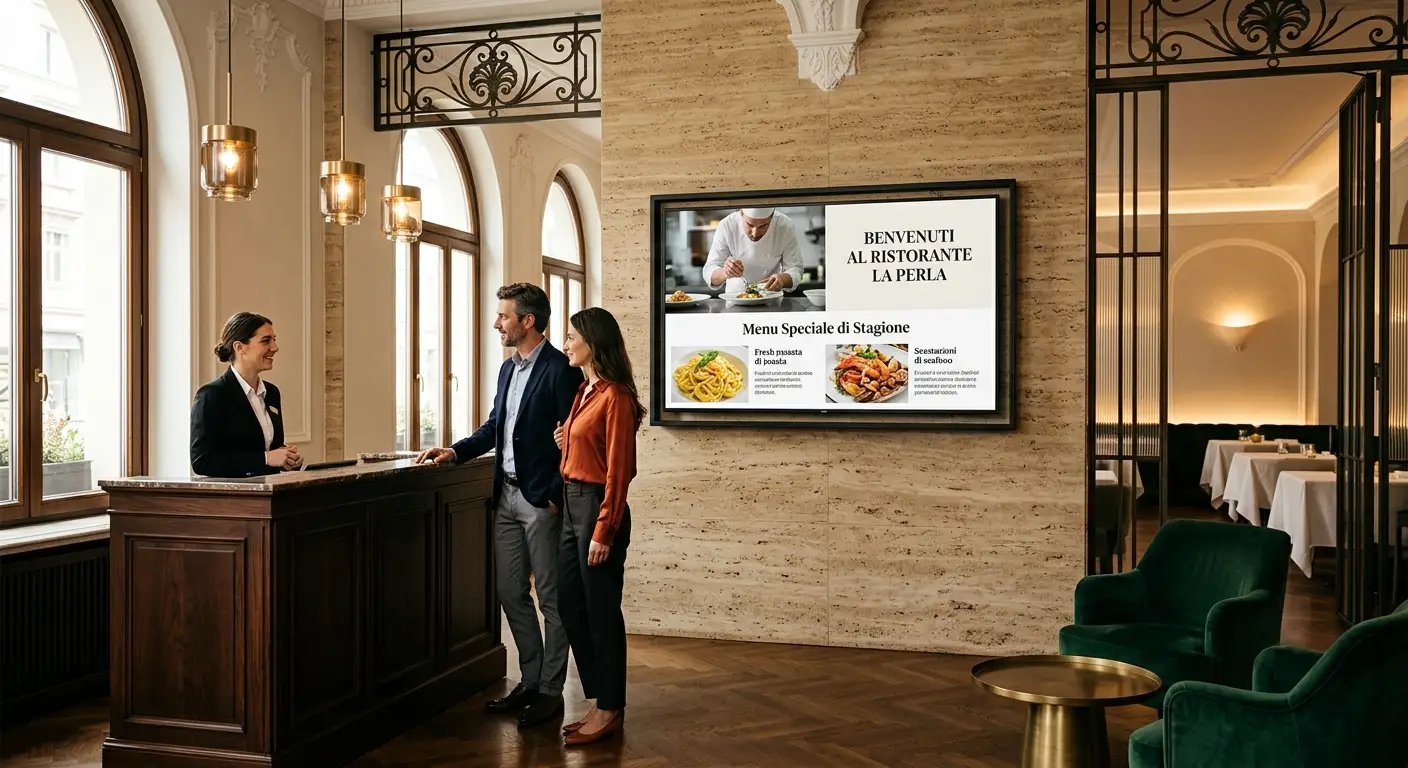
Commercial digital signage supporting brand storytelling in a fine dining lobby.
Hardware selection should follow the restaurant's layout and the customer's journey through it — not the other way around. Below is how leading fine dining brands typically match display hardware to each functional area.
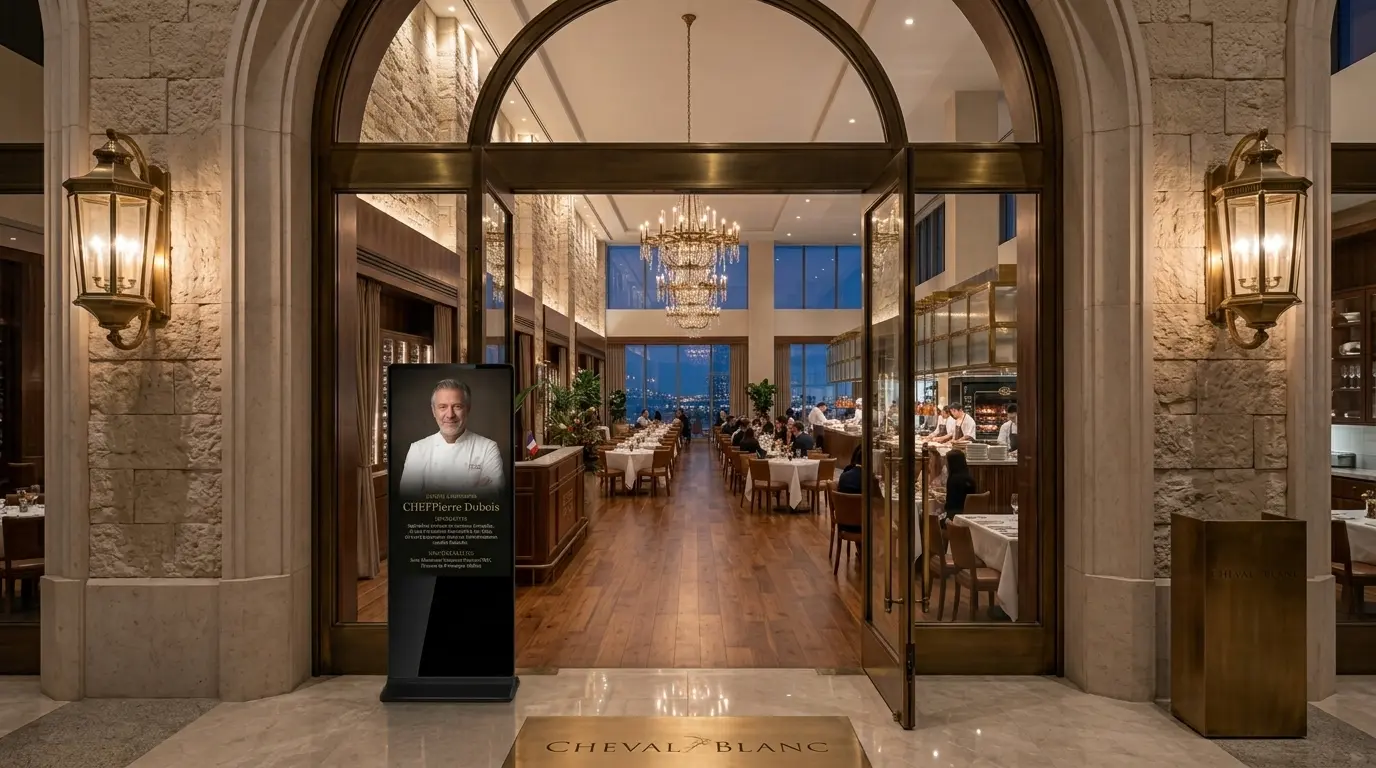
Floor standing digital signage — an outdoor-capable or high-brightness digital advertising display panel positioned at the entrance.
Where it's used: signature dish promotion, seasonal menu campaigns, chef introductions, brand storytelling, and event promotion, right where guests form their first impression.
Business value: a stronger first impression, higher guest interest before seating, and a natural spot to promote high-margin dishes before the order is even taken.
Wall-mounted digital signage display paired with a บอร์ดเมนูดิจิทัล for menu preview content.
Where it's used: menu previews, recommended dishes, wine pairing suggestions, and membership promotions while guests wait to be seated.
Business value: premium dishes get introduced earlier, ordering decisions improve before guests even sit down, and the wait itself becomes part of the brand story instead of dead time.
Digital menu board หรือก็อก wall-mounted commercial display built for continuous operation behind the bar.
Where it's used: wine lists, cocktail menus, beverage promotions, and limited-edition drink features.
Business value: compared to a printed wine list, a digital menu board can show product imagery, tell origin stories, and update availability in seconds rather than waiting on a reprint cycle.
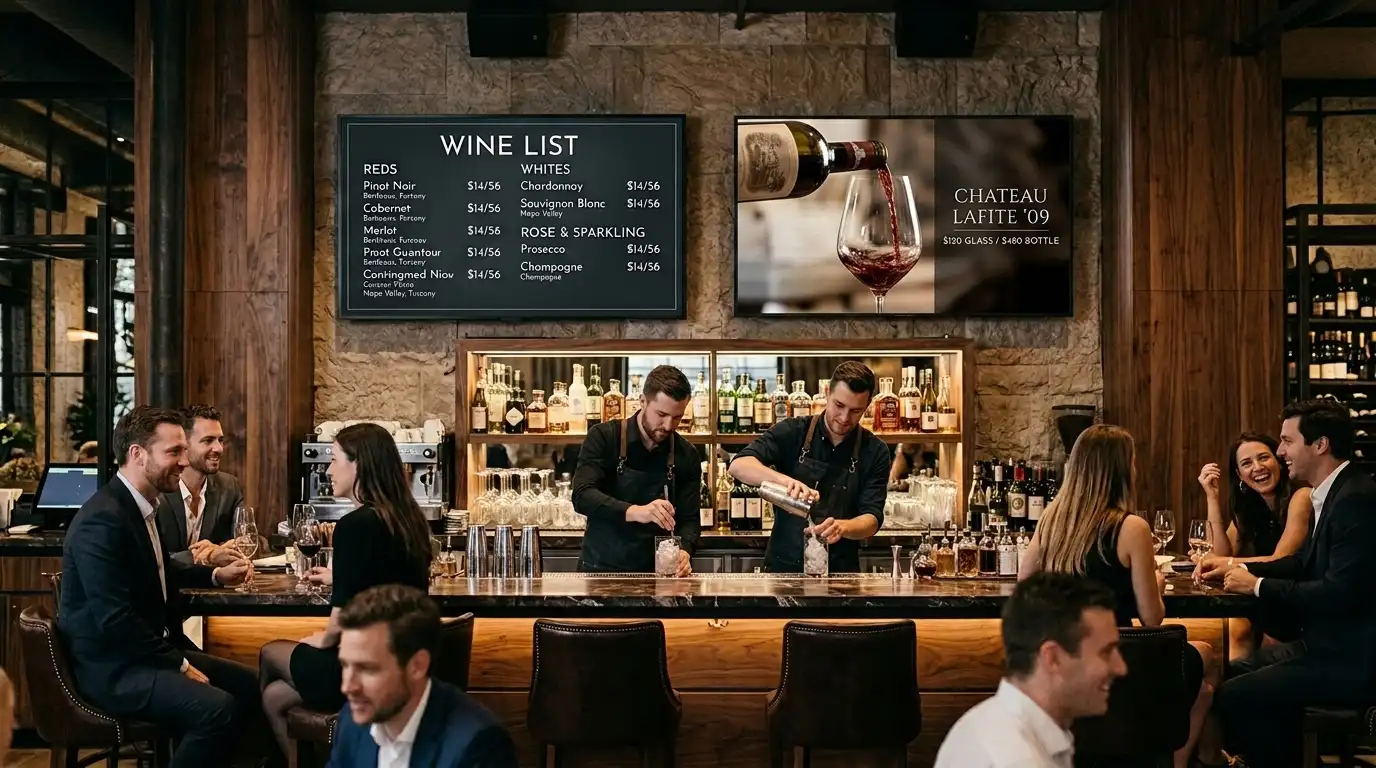
A digital menu board behind the bar keeps the wine and cocktail list current without reprinting.
Self-service ordering kiosk — a compact, tableside touchscreen ordering unit rather than a general-purpose display.
Where it's used: VIP rooms, private dining rooms, and other high-end settings where guests want to explore dish details, ingredient information, chef recommendations, and wine pairings directly, at their own pace.
Business value: according to kiosk-industry benchmarking, restaurants deploying self-service ordering hardware typically see average order value increase by 15–30%, driven by richer visual menu presentation and consistent upsell prompts — value that applies just as well to a VIP room as it does to a quick-service counter. It also frees staff to deliver more focused, professional service instead of repeating standard menu information.
Suited to: premium casual dining, hotel restaurants, restaurants with large or frequently changing menus.
Used for: menu browsing, dish customization, order submission, capturing feedback.
ประโยชน์ที่ได้รับ: fewer repetitive service interruptions, faster ordering, more upsell opportunities.
Suited to: high-volume restaurants, quick-service premium concepts, large restaurant groups.
Used for: self-ordering, payment, queue management.
Buyer considerations: POS compatibility, payment module integration, hardware durability under high-frequency daily use.
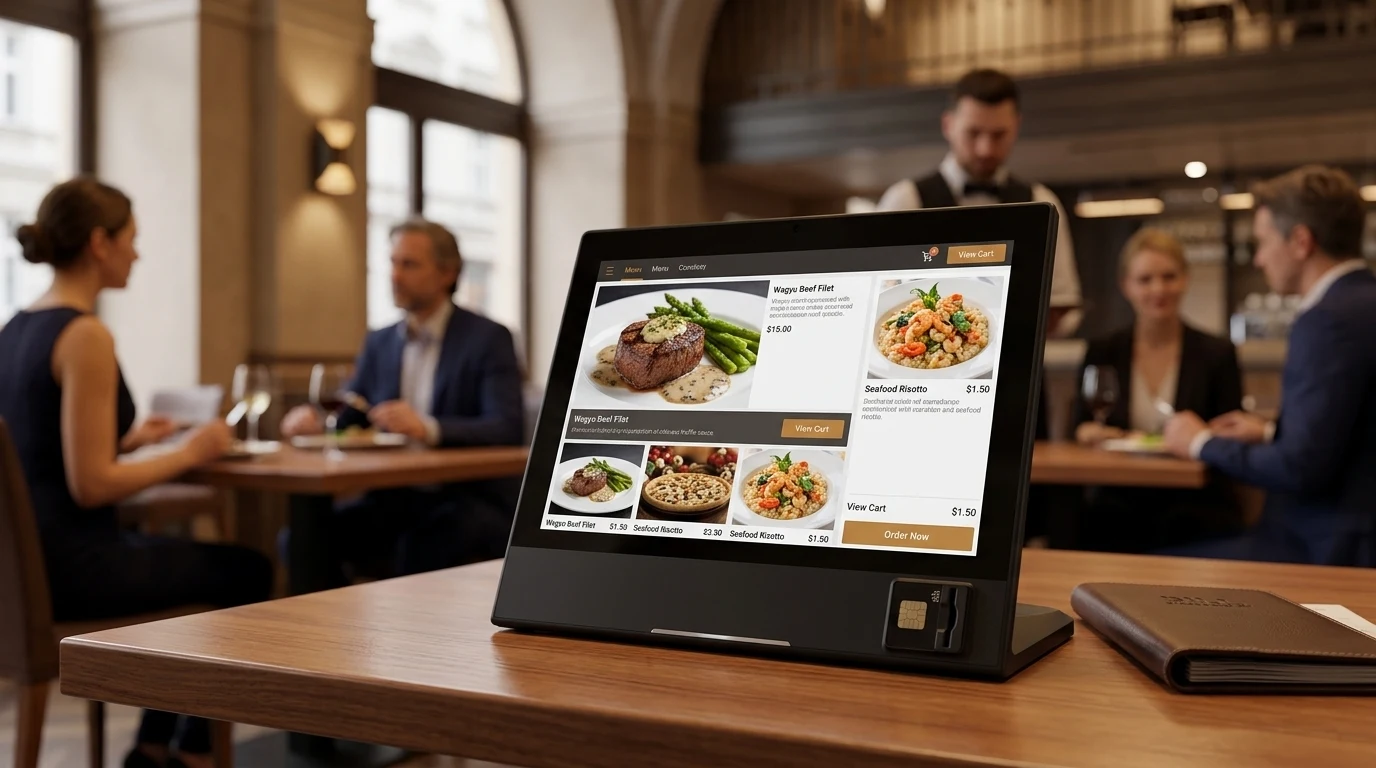
A self-service ordering kiosk with integrated payment module reduces queue time during peak hours.
Every restaurant floor plan is different. Talk to Qtenboard about a scenario-based hardware plan for your locations.
Contact Us for a Custom SolutionGrowing from 10 stores to 50 to 100+ locations requires the same display configuration everywhere, a consistent visual result panel-to-panel, and a supply chain that can actually deliver at that scale. Evaluate suppliers on long-term product availability, batch-to-batch hardware consistency, and real production capacity — not just a sample unit.
Display hardware doesn't operate in isolation — it needs to talk to CMS platforms, POS systems, ordering systems, and payment solutions. Evaluate software compatibility, API availability, and whether the media player supports both Android and Windows environments.
Off-the-shelf panels don't always match a premium brand's interior design, identity, or installation constraints. OEM hardware customization can cover:
Ask whether the supplier has actually deployed hardware in restaurant and hotel environments before, whether they can show real multi-location deployment examples, and whether they understand hospitality-specific requirements such as duty cycles, cleaning routines, and front-of-house aesthetics.
Evaluate OEM capability, software compatibility, peripheral integration (payment modules, printers, sensors), and support for custom accessories or mounts.
For international rollouts, check production capacity, realistic delivery timelines, spare-parts availability, and the actual terms of warranty support.
Background: A Dubai-based luxury restaurant group operating 5 premium dining concepts across 12 locations, serving an international clientele.
Challenges: inconsistent menu displays store to store, manual updates for every seasonal campaign, and limited pre-order interaction for guests in VIP rooms.
Hardware deployed:
ผลลัพธ์: unified brand presentation across all 12 locations, campaign and seasonal menu updates that used to take roughly two weeks to reach every store now reach the full fleet within 48 hours through the centralized CMS, and VIP-room self-service ordering kiosks contributed to a meaningful lift in average check size, consistent with the 15–30% range typically reported for self-service ordering hardware.
Background: A premium Italian restaurant group operating across 8 city locations, averaging roughly 40 tables per location, running a complex wine and menu system, and looking to improve service consistency during peak hours.
Challenges: staff spending significant time re-explaining menu details table by table, inconsistent wine recommendations across locations, and service pressure during peak dining periods.
Hardware deployed:
ผลลัพธ์: faster ordering during peak hours, more consistent wine pairing recommendations across all 8 locations regardless of individual server experience, and a meaningful reduction in the time staff previously spent on repetitive menu explanations — time that was redirected toward table-side service quality.
Whether you're deploying to 5 locations or 500, Qtenboard can help you plan the hardware mix before you buy.
Get a Custom SolutionQtenboard doesn't sell a single device — it plans a full hardware mix around how a restaurant actually operates. Solution design is based on:
| Restaurant Area | Recommended Solution |
|---|---|
| Entrance | Floor standing digital signage for brand promotion and seasonal campaigns |
| พื้นที่รอสินค้า | Wall-mounted digital signage display for menu preview and customer engagement |
| Bar Counter | Digital menu board / commercial display for wine and beverage showcase |
| VIP Dining Room | Self-service ordering kiosk for a premium, tableside menu experience |
| Ordering Area | Tabletop ordering device / self-service kiosk for efficiency improvement |
For large restaurant brands, standard off-the-shelf products may not fully match brand visual identity, store design requirements, or the installation environment. Qtenboard supports customization including:
Hardware customization:
Brand deployment support that helps brands:
Suitable for restaurant chains, franchise groups, and hospitality integrators.
For chain restaurant brands, the biggest challenge usually isn't sourcing the first batch of hardware — it's whether the same configuration will still be available for stores opening three years from now. Qtenboard supports:
Modern restaurant digitalization typically needs to connect a CMS, a POS system, an ordering platform, and a payment solution. Qtenboard provides hardware compatibility support for Android-based and Windows-based solutions, touch applications, and peripheral integration — for example, a self-ordering setup that combines display, touch, payment module, and POS integration into one working unit.
Overseas buyers care most about one thing: will this hardware actually clear the target market. Qtenboard provides production quality control, factory testing, and support for international certifications including CE, FCC, and RoHS — helping customers reduce deployment risk, compliance issues, and after-sales uncertainty.
From a single pilot store to a 100+ location rollout, Qtenboard works as a hardware partner across the full project lifecycle — solution design, OEM customization, production, and after-sales support.
Yes — entrance signage, menu boards, self-service kiosks, and ordering terminals can be planned and sourced as one coordinated hardware package rather than separate purchases.
It depends on the area: a digital menu board suits passive viewing zones like waiting areas and bars; a self-service kiosk suits zones where guests actively browse, customize, and place orders, such as ordering counters and VIP rooms.
Compatibility depends on the media player's OS (Android or Windows) and available APIs — this should be confirmed against your current POS stack before ordering.
This depends on store layout and the number of functional areas per location. A scenario-based hardware plan, matched to entrance, waiting area, bar, VIP room, and ordering area, is the right starting point for sizing a rollout.
Yes, through OEM hardware customization — enclosure, screen size, and mounting structure can all be adapted to interior design requirements.
Through spare-parts availability, defined warranty terms, and production and delivery planning suited to international timelines.
Store count, area-by-area hardware needs, target screen sizes, install environment (indoor or outdoor), and any POS or ordering systems that need integration.
For premium restaurant brands, digital displays aren't just screens — they're part of the customer experience strategy, the brand communication system, and the restaurant's operational infrastructure. The right hardware supplier brings scenario-based solutions, reliable commercial-grade panels, real OEM capability, and support that lasts through the full lifecycle of a multi-location rollout.
Talk to Qtenboard about matching entrance signage, digital menu boards, and self-service ordering kiosks to your restaurant's layout — contact us to start planning your rollout.

 TH
TH
 EN
EN  AR
AR  DAN
DAN  IT
IT  ARM
ARM  FIN
FIN  SWE
SWE  NOR
NOR  MAY
MAY  NL
NL  KOR
KOR  PL
PL  JP
JP  RU
RU  PT
PT  SPA
SPA  FRA
FRA  DE
DE  CHT
CHT 