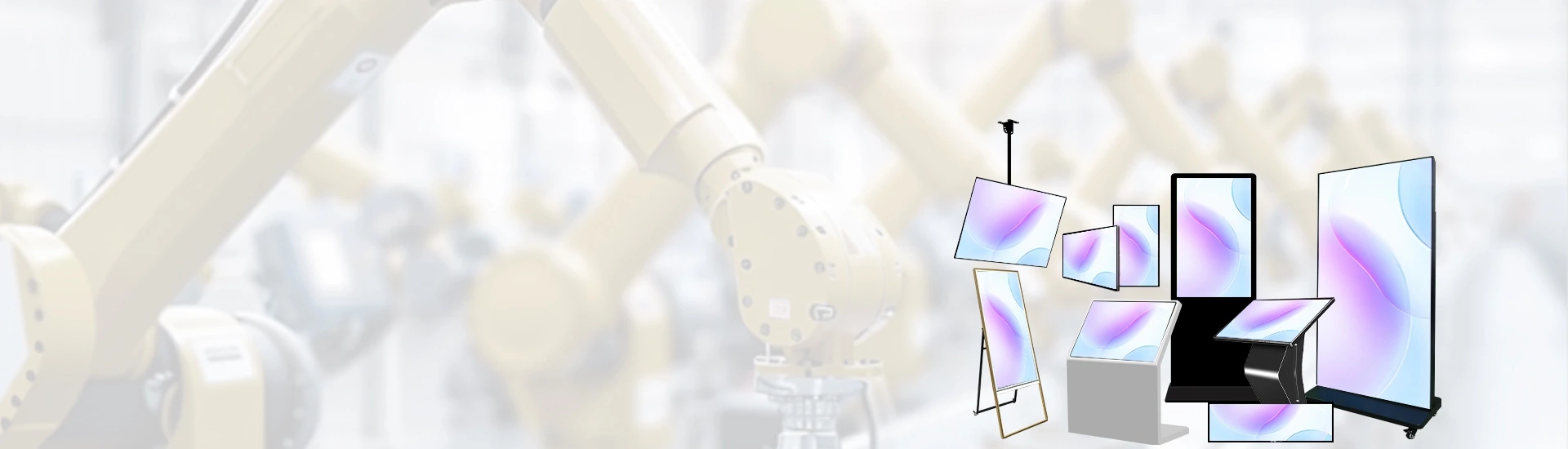
Sourcing self-service terminals, queuing terminals, or kiosk terminals for a B2B project? Qtenboard manufactures industrial-grade touch hardware in Shenzhen — Android and Windows, standard models and custom modules, from queue ticket machines to terminals with coin pulse input integration. Tell us your project requirement and get engineering-level support.

Selection criteria for self-service terminals, digital terminals and kiosk hardware in B2B projects.
Most self-service terminal projects fail during integration, not during the sale. The specification decides touch accuracy, software compatibility and uptime for the life of your deployment. Match each module to your workload before you compare supplier quotes.
| Parameter | Available Options |
|---|---|
| Skjermstorleik | 32" / 43" / 49" / 55" / 65" |
| Oppløysing | 1920×1080 (FHD) / 3840×2160 (4K UHD) |
| Lysstyrke | ≥300 / 400 / 500 cd/m² |
| Visvinkel | 178° |
| Røretype | Capacitive / Infrared, 10–20 points |
| Operativsystem | Android 11 / 14 / 16 · Windows 10 / 11 / Pro |
| CPU: | Intel i5 / i7 · Rockchip RK3588 |
| RAMS | 4GB / 8GB / 16GB |
| Lagring | 64GB / 128GB / 256GB / 512GB |
| Grensesnitt | HDMI ×1 (4K@60Hz) · USB ×2 / ×4 · Ethernet 10/100/1000M · WiFi 2.4G / 5G · Bluetooth 5.0 / 5.4 |
| Chassis Material | Aluminum / SPCC Steel · 3mm Tempered Glass |
| Sertifiseringer | CE / FCC / RoHS / ISO 9001 |
* Reference model: 43-inch QM-C43XJ-P. Additional options include 120Hz panels, 10-bit color, WiFi 6, 4G/5G modules, card readers, RFID and NFC.
| Decision | Option A | Option B |
|---|---|---|
| Berøringsteknologi | PCAP — smooth multi-touch (10–20 points) for maps, menus and self-service flows | Infrared — works with gloves and stylus, large formats, sunlight-readable |
| Operativsystem | Android — CMS content playback, fast boot, lighter deployment | Windows — custom software, SDK/API-heavy integrations, legacy systems |
| Chassis | Cold-rolled steel — heavy traffic, tamper resistance, 24/7 venues | Aluminum — lighter, design-forward, lower maintenance weight |

Need the full specification sheet and model list? See the K-Type information kiosk product page for complete self-service terminal hardware parameters.
Queue ticket machines, number calling systems and queue management hardware for high-traffic service venues.
Long queues are the top complaint in service venues — 78% of bank customers cite wait time as the main reason for a poor branch experience (2024 Global Banking Customer Experience Report). A queuing self-service terminal that breaks down at peak hours makes it worse, which is why queue hardware is built around printer durability, peak-hour reliability and software integration.

See the bank queue management system procurement guide for queue ticket machine and number calling system details, or the K-Type information kiosk product page for floor-standing terminal hardware.
Coin acceptor modules, payment peripherals and retrofit customization for unattended environments.
Unattended venues — laundromats, amusement centers, storage lockers and vending retrofit projects — often need terminals that accept coins without a network connection. Qtenboard integrates coin acceptors into self-service terminals via pulse counting input or RS232 serial interface, with anti-jam and anti-cheat hardware design, so the terminal can run fully offline.

The difference between a transaction terminal and a display screen.
Self-service kiosks and digital signage look similar on a product list and behave very differently on site. If your project needs tickets, payments or data input, you need a kiosk terminal. If it only needs content playback, a signage screen is the right call.
| Funkjon | Kiosk Terminal | Digital signal |
|---|---|---|
| Kjernefunksjon | Self-service transactions: ticketing, queuing, check-in, payment | Content playback: advertising, menus, wayfinding |
| Interaction | Touch input, data entry, user accounts | View-only, remote content updates |
| Peripherals | Printer, scanner, card / NFC reader, coin module | None (speakers optional) |
| Programvaren | Custom application, API/SDK, MDM | CMS playback and scheduling |
| Deployment | Transaction-critical, 24/7 reliability | Display-critical, scheduled operation |

Make your terminal hardware work with your existing software stack.
Hardware that cannot connect to your queuing software, CRM or device management platform becomes a maintenance burden. Qtenboard terminals support both Android and Windows, expose API and SDK for custom queue logic and third-party development, and ship with remote device management (MDM) for firmware, content and health monitoring.
Android suits CMS content, advertising playback and fast boot. Windows suits custom applications and heavy SDK/API integration, including in-house queuing logic and legacy banking systems.
Update firmware and content remotely, monitor device health and push emergency messages across multi-branch deployments — without visiting each site.

Why buying terminal hardware from a factory beats buying from a trader.
Importing kiosk hardware from a trading company means no quality control, no engineering support and no spare parts. Qtenboard has operated its own terminal factory since 2005, with a 330,000㎡ production base in Shenzhen and Guangzhou, 8 automated production lines and a 300-unit daily output capacity. Every unit passes a 48-hour aging test before shipment.


Published deployments across banking, transport, healthcare and retail.
50 queue ticket machines with 4K anti-glare displays, CRM API integration and AI queue optimization, installed and staff-trained within 2 weeks.
Self-service information terminals running 24/7 in high-traffic transport hubs for wayfinding, schedule look-up and passenger services.
Terminals deployed in hospitals and public service centers for navigation, announcements and service queue management in public halls.
Dynamic digital menus and promotional screens for restaurant chains, with self-service ordering kiosks for faster checkout.

Power, network, spare parts and remote support for multi-country rollouts.
Direct answers for system integrators and project buyers.
A kiosk terminal is the full transaction unit — touch display, chassis, peripherals and software. A self-service terminal is the broader category covering kiosks, queue ticket machines and custom configurations for specific workflows.
Yes. Qtenboard integrates coin acceptor pulse input, card readers, NFC/RFID, QR scanners, thermal printers and biometric modules into self-service terminals. Hardware customization has an MOQ of 30 units; brand customization starts from 1 unit.
Terminals support Android 11 / 14 / 16 and Windows 10 / 11 / Pro. Android suits CMS content and advertising playback; Windows suits custom applications and heavy SDK integration.
Yes. Our number calling system exposes API and SDK for custom queue logic, with pre-built APIs for Salesforce Financial Services, SAP Banking and Oracle Financials, plus custom integration for in-house systems and free post-integration testing.
Standard units ship in 7–15 business days. Customized units (branding, hardware or software changes) take 15–25 business days. Bulk orders of 50+ units can be accelerated on request.
Yes. OEM/ODM covers brand logo, boot animation, UI/OS deep customization, chassis and color, custom packaging, SN tracking, and CKD/SKD supply for local assembly.
Terminals carry a 1–3 year standard warranty. Support includes 24/7 multilingual assistance, over 95% of technical issues resolved remotely within 2 hours, and spare parts dispatched within 48 hours from warehouses in Shenzhen, Frankfurt and New York.
Yes. Sample units ship via express delivery in 3–7 business days with a full testing guide, so your team can validate performance, durability and integration before placing a bulk order.
Our engineering team responds to project inquiries within 2 business hours — specifications, integration advice and a custom quote included.

 NOR
 EN
 AR
 DAN
 IT
 ARM
 FIN
 SWE
 MAY
 NL
 TH
 KOR
 PL
 RU
 PT
 SPA
 FRA
 DE
 CHT
