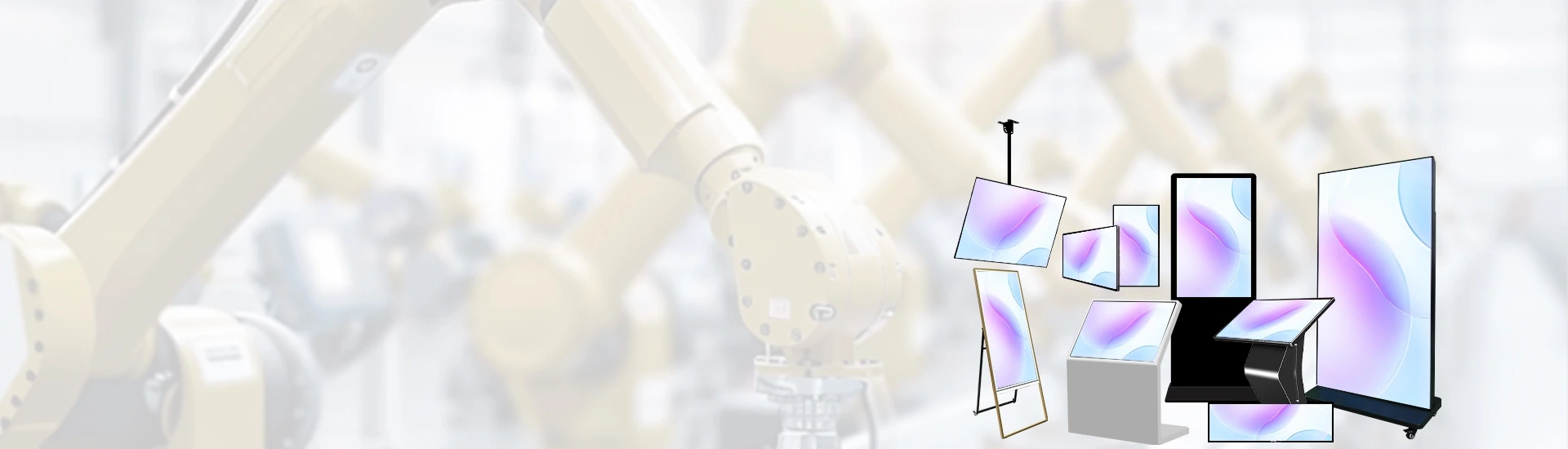
Printed menu boards are quietly disappearing from restaurants, school cafeterias, hospital bistros, and commercial lobbies across North America and Europe. The reason is practical: a single price change on a printed board costs hours of labour, a reprint fee, and a window of operational downtime. An indoor digital menu board solves that problem in seconds.
This guide is written for B2B procurement teams, franchise operators, facilities managers, and AV integrators evaluating Binnen Digitale menuborden for multi-location deployment. It covers the four decisions that matter most — brightness, size, installation method, and system integration — then maps each decision to real deployment scenarios across restaurants, schools, hospitals, and commercial lobbies. Every specification range and case reference below reflects what commercial buyers actually encounter in the field, not theoretical maximums.
Een indoor menu board is a commercial-grade display purpose-built for interior environments where viewing distance is short (1–5 metres), ambient lighting varies from dim to moderately bright, and content changes frequently. Unlike a consumer television repurposed for signage, an indoor digital menu board is engineered for continuous duty cycles, centralised content control, and consistent colour reproduction across every screen in a network.
The term "System & Display" captures two distinct procurement layers that buyers must evaluate separately:
A frequent procurement mistake is selecting a display purely on price per inch, then discovering that the system layer cannot support multi-store batch updates or POS price synchronisation. For a detailed look at how Qtenboard structures the system layer, including cloud CMS and multi-device content delivery, see the Qtenboard indoor digital signage product page, which covers the hardware and software specifications available for commercial deployments.
Brightness is the single specification that most directly determines whether a menu board is readable in its installed environment. The measurement is nits (cd/m²). For indoor deployments, the relevant range is 250–1,500 nits. Anything above 1,500 nits is typically reserved for semi-outdoor or window-facing applications.
| Milieu | Recommended Brightness | Typical Locations |
|---|---|---|
| Dim indoor (controlled lighting) | 250–400 nits | Fine dining, hospital cafeterias, hotel restaurants |
| Standard indoor (well-lit) | 400–700 nits | Fast food counters, school dining halls, corporate cafeterias |
| Bright indoor / window-adjacent | 700–1,500 nits | Street-facing QSR, lobby displays near glass walls |
Under-brightness causes washed-out colours and glare from overhead lighting. Over-brightness in a dim room creates visual fatigue for staff reading the board eight hours a day. For most indoor restaurant and institutional deployments, 400–700 nits with an anti-glare coating delivers the best balance. Indoor digital menu display panels from commercial manufacturers typically offer auto-brightness adjustment, which is worth specifying for locations with variable daylight.
There is no universal "best size." The correct screen diagonal depends on the maximum viewing distance at which a customer must read the smallest text element — usually a price or allergen note.
As a practical rule, the height of the smallest text on screen should be at least 1/200th of the maximum viewing distance. If customers read a price from 3 metres away, that price text should be no shorter than 15 mm on screen.
The installation decision is driven by space constraints, visual priority, and maintenance access. Both methods are valid, but they serve different operational contexts.
| Factor | Aan de muur gemonteerd | Staande vloer |
|---|---|---|
| Space footprint | Zero floor space; hugs wall | Requires 0.5–1 m² floor area |
| Visual prominence | Integrates into wall; less dominant | Freestanding; commands attention |
| Installation complexity | Requires wall structure assessment, VESA bracket | Base assembly; cable management through pedestal |
| Maintenance access | May require ladder for high mounts | Accessible at standing height |
| Best-fit environments | Restaurant counters, hospital corridors, classroom walls | Hotel lobbies, mall food courts, corporate atriums |
| Power/network routing | Cable management through wall cavity | Internal pedestal channel; easier retrofit |
For wall-mounted deployments, Qtenboard offers wall-mounted and ceiling-hanging digital signage configurations in 50-inch and 55-inch panel sizes, with optional portrait or landscape orientation and centralised cloud management for multi-store retail and QSR environments.
The system layer is where a deployment succeeds or fails at scale. A single-location restaurant can manage content via USB. A ten-location franchise cannot. Procurement teams should verify the following capabilities before finalising a hardware specification:
Qtenboard's Digitale bewegwijzering binnenshuis hardware supports Android and Windows operating systems with cloud CMS control, multi-device content delivery, layout editing, batch updates, scheduled on/off, and role-based access. The desktop digital menu board series from Qtenboard additionally supports POS and ordering system integration with offline playback modes, which is relevant for counter-service restaurants where network reliability cannot be guaranteed.
Commercial indoor digital menu boards are specified for 24/7 operation. This means the panel, power supply, and thermal management system must be rated for continuous duty — not the 8-hour duty cycle of a consumer display. Qtenboard commercial displays are tested with 48-hour continuous aging at the factory and support an operating temperature range of ‐5°C to 60°C, which covers most indoor environments including non-climate-controlled stockrooms and kitchen-adjacent mounting positions.
For international deployments, verify that the hardware carries the certifications required by the destination market: CE and RoHS for the European Union, FCC for the United States, PSE for Japan. Qtenboard commercial displays ship with CE, FCC, and RoHS certification as standard, with UL and PSE available as optional certifications depending on the destination market.
Total cost of ownership for an indoor digital menu board deployment includes hardware, installation, CMS subscription (if applicable), content design, and ongoing maintenance. The business case typically rests on elimination of printing costs, reduction in staff labour for menu updates, and measurable increases in average transaction value through dynamic merchandising. For B2B buyers building a TCO model, request a specification sheet and a sample ROI calculation from the supplier before committing to a multi-location rollout.
The specifications above become concrete when mapped to actual deployments in specific countries. The cases below illustrate how brightness, size, installation, and system requirements combine differently depending on the operational context.
Apostolos Grill is a Greek restaurant and delivery service operating in Gelsenkirchen since 1983. The restaurant replaced its printed menu boards with six digital signage screens: four 42.5-inch and two 55-inch models with 4K resolution and 400 nits brightness, mounted with wall brackets and updated via USB. The entire project was completed within seven days from order to delivery, and the restaurant owner installed the screens personally, reflecting the plug-and-play simplicity required by small and medium-sized restaurant operators.
Key takeaway for B2B buyers: For a single-location restaurant with limited IT resources, a 400-nit display with USB content updates is sufficient. The installation method was wall-mounted, the size range 42.5–55 inches matched the counter-to-customer viewing distance, and the system layer was deliberately minimal to avoid operational complexity.
Mr. Pickle's Sandwich Shop, a growing premium sandwich chain in the United States, implemented Samsung digital menu boards alongside self-service kiosks to enhance customer experience and streamline operations across its locations. The deployment included both kiosk ordering and dynamic menu boards, creating a coordinated front-of-house digital environment.
Key takeaway for B2B buyers: This case illustrates the value of treating kiosk ordering and menu board display as a single system layer. When kiosks and menu boards share a CMS and POS integration, promotions and pricing remain synchronised across both customer touchpoints.
TORTILLA, a fast-food group operating in France and the UK, deployed 300 Sony professional displays as digital menu boards across its sites. The deployment used 43-inch displays, a size selected for counter-service viewing distances. The scale of the rollout — 300 units across two countries — required a system layer capable of centralised content management and consistent brand presentation across every location.
Key takeaway for B2B buyers: Multi-country deployments introduce language variation, local pricing, and regulatory differences (e.g., allergen labelling requirements) that a central CMS must accommodate without requiring separate hardware configurations per market. The 43-inch size is a proven standard for QSR counter environments.
Famous Wok deployed chain-wide QSR menu boards across Canada and the United States using E Display digital signage. The deployment covered multiple locations requiring consistent menu presentation, promotional rotation, and centralised content control. The case demonstrates the operational value of choosing a display and CMS combination that can be replicated across a franchise network without per-location customisation.
Key takeaway for B2B buyers: When evaluating indoor digital menu boards for a franchise network, prioritise suppliers that can deliver identical hardware specifications across all locations and a CMS that supports template-based content deployment. This reduces training requirements and ensures brand consistency.
Dresden University Hospital implemented a digital food ordering system that combined traditional information displays with digital menu boards in the hospital restaurant area. Two 43-inch digital signage displays and three digital menu boards were installed in bistro areas, extending the system to multiple dining zones within the hospital campus. The content structure maintained consistency between menu information and facility announcements.
Key takeaway for B2B buyers: In healthcare environments, the display must balance menu visibility with a non-aggressive brightness level suitable for patients and visitors who may be sensitive to glare. The 43-inch size and wall-mounted installation suited the bistro environment's viewing distances and space constraints.
| Scenario | Helderheid | Grootte | Installatie | System Priority |
|---|---|---|---|---|
| Fast Food / QSR counter | 500–700 nits | 43–55" | Wall-mounted or ceiling-hung | POS integration, real-time price sync |
| School / university cafeteria | 400–700 nits | 55–65" | Aan de muur gemonteerd | Scheduled menu rotation, multi-language |
| Hospital bistro / cafe | 350–500 nits | 43–55" | Aan de muur gemonteerd | Low-glare panel, announcement overlay |
| Commercial lobby / atrium | 700–1,000 nits | 65–86" | Vloerstaand | Brand content, wayfinding, dynamic display |
| Corporate cafeteria | 400–700 nits | 43–65" | Wall or floor | Menu rotation, nutrition data, internal comms |
Voor lobby digital menu applications in commercial buildings, the display is often shared between wayfinding, brand messaging, and dining information. This multi-purpose use case favours larger formats and a CMS that supports zone-based layout scheduling, so the same screen can present a lobby directory in the morning and a dining menu at lunch. Qtenboard's digital signage solution updates cover multi-zone split-screen capabilities managed through the cloud CMS, which is directly applicable to shared lobby displays.
For B2B buyers evaluating indoor digital menu board suppliers, the selection criteria extend beyond panel specifications. Supply reliability, certification coverage, customisation capability, and after-sales responsiveness carry equal weight in a multi-location procurement decision. Qtenboard operates two manufacturing bases in Shenzhen and Guangzhou with a combined production area of over 330,000 m² and a daily production capacity of 200 units. Every unit undergoes 48-hour continuous aging testing before shipment, and the production process supports CE, FCC, RoHS, PSE, and optional UL certifications for international market compliance.
The company's service model includes 24/7 online technical support, a multilingual sales team experienced in cross-border commercial deployments, and OEM/ODM support for buyers requiring custom bezel colours, logo integration, or UI branding. For integrators and distributors, Qtenboard offers long-term supply agreements and direct factory pricing without intermediary margins. Buyers can review ongoing deployment insights and technical articles through Qtenboard's kiosk and digital signage news En product deployment updates, or reach the global sales team through the Qtenboard contact page to discuss specification requirements, sample orders, and volume pricing.
What brightness level works best for a dimly lit restaurant versus a sunlit lobby?
For dimly lit dining rooms, 250–400 nits is sufficient and avoids visual fatigue. For a lobby with large glass walls and direct daylight, specify 700–1,000 nits with an anti-glare coating. If the display faces a window and is visible from outside during daylight hours, 1,000–1,500 nits may be necessary, though this begins to overlap with semi-outdoor specifications.
Should I choose wall-mounted or floor-standing installation for my space?
Wall-mounted is the default for service counters, cafeteria lines, and corridors because it preserves floor space and keeps the display at a natural reading height for customers standing at a counter. Floor-standing is appropriate for lobbies, atriums, and open public areas where the display needs to be a focal point and maintenance access from ground level is an operational priority.
What screen size do I need based on typical viewing distance?
Use 22–32 inches for under 2 metres, 43–55 inches for 2–4 metres, and 65–86 inches for 4–8 metres. The minimum text height rule is 1/200th of viewing distance. Always test with the actual menu content and font sizes planned for deployment before finalising the screen size.
Is remote batch management available for multi-location businesses?
Yes, provided the display hardware and CMS support it. Cloud-based CMS platforms allow central teams to publish content to all screens, schedule promotions, and push emergency updates across a network of locations from a single dashboard. Verify that the CMS supports offline playback so that screens continue to display content if the network connection drops.
How long can indoor digital menu boards run continuously without issues?
Commercial-grade indoor menu boards are specified for 24/7 operation. The critical factors are thermal management and panel design. Qtenboard commercial displays undergo 48-hour continuous aging tests and support operating temperatures from ‐5°C to 60°C, making them suitable for continuous duty in restaurant and institutional environments.
Can indoor digital menu boards integrate with existing POS or menu management systems?
Integration depends on the system layer. Qtenboard hardware supports Android and Windows operating systems with compatibility for mainstream POS and ordering systems, enabling order synchronisation, price updates, and availability management. Buyers should provide their POS API documentation to the supplier during the specification phase to confirm compatibility before purchase.
Planning a multi-location deployment of indoor digital menu boards? Qtenboard provides commercial display hardware, cloud CMS integration, and OEM/ODM customisation for restaurant chains, educational institutions, healthcare facilities, and commercial property operators.
Request a Custom Specification & Volume Pricing
 NL
NL
 EN
EN  AR
AR  DAN
DAN  IT
IT  ARM
ARM  FIN
FIN  SWE
SWE  NOR
NOR  MAY
MAY  TH
TH  KOR
KOR  PL
PL  JP
JP  RU
RU  PT
PT  SPA
SPA  FRA
FRA  DE
DE  CHT
CHT 