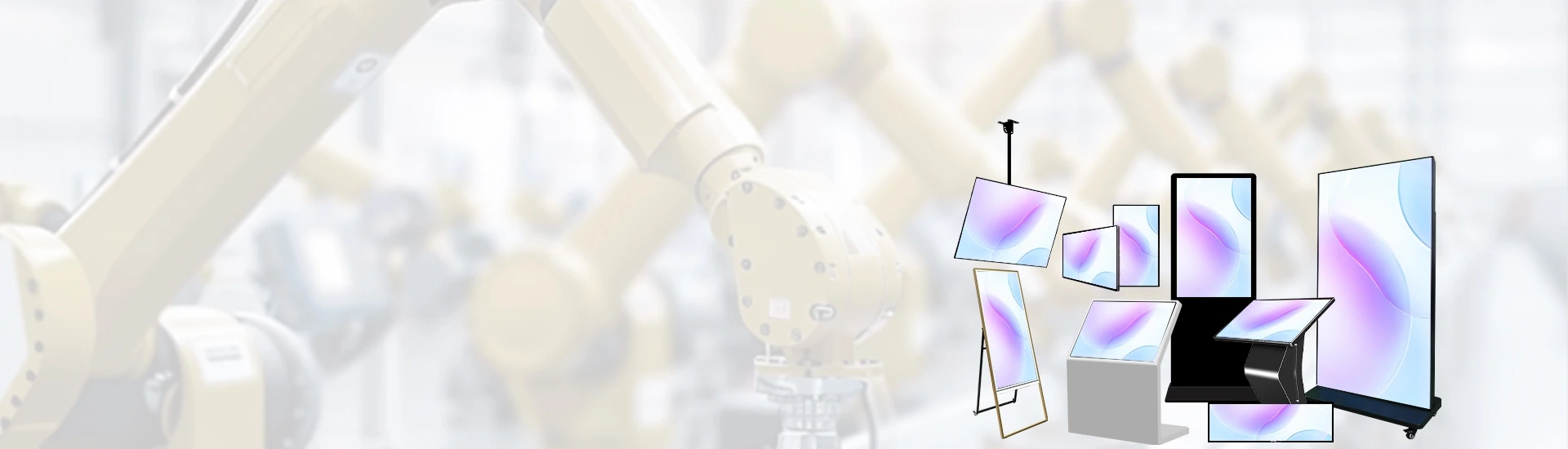
A complete digital menu board costs $500–$2,000+ per screen upfront, plus $0–$80 per screen per month in software. This guide breaks down every component that shapes digital menu price in today's market, from screen size and indoor/outdoor configuration to software tiers and real-world ROI. Whether you're a single-location cafe or a multi-site chain, you'll find a cost tier that matches your operation.
The most common question we hear from B2B buyers is straightforward: what does a digital menu board actually cost? The answer depends heavily on screen size, but the table below gives you a reliable starting point.
| 화면 크기 | Entry-Level Commercial Display | Mid-Range Commercial Display | 에 대한 베스트 |
|---|---|---|---|
| 32"–43" | $280–$560 | $420–$850 | Cafes, small QSR, single-counter service |
| 50"–55" | $520–$780 | $780–$1,200 | Most common size for menu boards |
| 65"–75" | $720–$1,100 | $1,100–$2,500 | Multi-column menus, high-visibility positions |
Prices reflect hardware only. Installation, software, and content design are additional line items covered below.
A consumer TV at $200–$500 may look like a bargain, but in commercial use its warranty voids immediately and the panel typically degrades within 18 months under continuous operation. Commercial-grade displays are rated for 16–24 hours of daily use, which is standard in restaurant environments.
For operators evaluating indoor digital signage options at the entry level, a 43-inch indoor digital signage display offers a practical balance between visibility and budget for counter-service layouts.
This is the single largest cost variable in any digital menu board project, and it's where most B2B buyers get caught off guard.
The price difference comes down to engineering. Outdoor displays need 2,500–3,500 nits of brightness to remain readable in direct sunlight and IP-rated enclosures to survive rain, dust, and temperature swings. Indoor boards operate at 350–700 nits in a climate-controlled space, which is a fundamentally different product category.
If your operation doesn't include a drive-thru or outdoor ordering point, you can reasonably skip this section and focus on the indoor pricing above.
One of the most persistent misconceptions in B2B digital signage procurement is that the screen price represents the project cost. In reality, hardware typically accounts for only 40–55% of total spend. Software, installation, content design, and ongoing maintenance fill the gap.
| Procurement Path | Upfront Per Screen | Monthly Per Screen | 에 대한 베스트 |
|---|---|---|---|
| DIY (consumer TV + free software) | $200–$500 | $0 | Single-screen test, non-critical use |
| Hardware-only (commercial display + paid software) | $800–$2,500 | $8–$40 | Operators who want control without vendor lock-in |
| Full package (hardware + software + install + design) | $1,500–$4,000+ | $10–$80 | Chains, multi-screen, zero-IT-staff operations |
The hidden math: If you compare a $400 consumer TV to a $1,200 commercial display, the commercial option looks 3× more expensive. But factor in a replacement TV at month 18, lost sales during downtime, and the absence of warranty coverage, and the "cheap" option often costs more within two years.
Rather than quoting a single price point, the industry has converged on three tiers that map to real operational profiles. Use these as a budget framework, not a rigid quote.
For a deeper look at how screen layouts and menu configurations differ across these tiers, the digital signage configuration guide covers common deployment patterns and hardware combinations.
Now that you have baseline numbers, here's why the same "menu board" can be quoted at $800 or $3,500 depending on configuration.
Commercial displays are rated by nits (brightness) and duty cycle. A 500-nit indoor display and a 3,000-nit outdoor display are not the same product at different price points; they use different panel technologies and cooling systems. For indoor applications, the difference between a 400-nit entry panel and a 700-nit mid-range panel is visible in glare-heavy environments like counter-facing installations.
Free plans exist and can work for a single screen. Paid tiers ($8–$40/month) add POS integration, multi-user permissions, and scheduling. Enterprise tiers ($100+/month) add API access, SLA guarantees, and dedicated support. The cost difference isn't about feature count; it's about operational risk when something breaks during peak service hours. For a side-by-side breakdown of CMS capabilities, see this digital signage software comparison.
Bulk procurement changes the math significantly. Wholesale platforms show per-unit display pricing dropping from $225 at small quantities to $122 at 500+ units. Custom branding (logo placement, housing color, screen bezel) adds 10–25% to hardware cost but may be waived at volume commitments.
This comparison is where the ROI case becomes concrete. The table below uses conservative industry averages for a single indoor screen.
| Cost Item | Printed Menu (Annual) | Digital Menu Board (Annual) |
|---|---|---|
| Initial / upfront | $150–$1,500 per print run | $800–$2,500 per screen |
| Reprints (2–4× per year) | $600–$4,800 | $0 |
| Software subscription | $0 | $96–$480 per screen |
| Update labor | ~15 min per panel per change | ~0 (centralized push) |
| 3-year total (single screen) | $1,800–$14,400+ | $1,100–$4,000+ |
The break-even point depends on menu update frequency. If you change pricing or promotions more than 2–3 times per year, the digital option's 3-year total cost of ownership falls below the printed alternative. If you update once a year and operate on a very tight budget, a printed menu with a QR code supplement remains a rational short-term choice.
The following case studies represent verified deployments across multiple markets and restaurant formats. Each illustrates a different cost-to-return profile.
McDonald's deployed digital menu boards across U.S. locations beginning in 2019, investing $2.8 billion in restaurant technology overall. A Forrester study commissioned by Samsung measured the results of a 10-store outdoor digital menu board pilot and found a 196% return on investment, with the system paying for itself in 11 months. The study also reported a $30,000 annual reduction in printing costs per store and a 2.5% increase in average order value. Same-store sales climbed 5.7% in Q2 2019 following the rollout, with the company attributing the lift partly to dynamic menu boards driving high-margin add-on purchases.
KFC digitized menu boards across 850 restaurants in the UK and Ireland, replacing static printed menus with a centrally managed system. Each restaurant received 5 screens (mostly 47" and 55" commercial displays) with speakers and NUC PCs. The system supports multi-day-part programming, so promotional and pricing content updates automatically across all locations. Each display connects directly to the restaurant's POS system, ensuring pricing accuracy in real time. The Drive-Thru solution uses high-brightness screens in weatherproof enclosures, with each site going live within a three-day window to minimize operational disruption. For a closer look at how multi-location deployments are structured, see this multi-location digital signage case study.
Little Caesars completed a global rollout of cloud-managed digital menu boards across thousands of restaurants in 16 countries in under six months. The deployment moved the chain from a manual, location-by-location process to a fully integrated system with real-time pricing, availability, and regional variation updates. The custom menu board application built within the CMS allows central control while accommodating local market differences. For a brand operating on thin margins and a $5 price point, the centralized management model eliminated per-location manual updates that had previously consumed staff time and introduced pricing errors.
Juici Patties, a QSR chain in St. Ann, Jamaica, installed its first outdoor digital drive-thru menu board alongside indoor digital menu boards. The installation used a 55" outdoor display in an IP54-rated weatherproof enclosure with a mount designed for airflow to prevent overheating in tropical conditions. The deployment took two weeks across two phases, with both indoor and outdoor installations completed within hours once on site. The franchise chose a modular design that allows static panels to be upgraded to digital displays in the future without disturbing adjacent units.
BenBry Burgers, a takeaway restaurant in Manly, Australia, cut printing costs by 90% after installing digital menu boards. The system paid for itself through a combination of increased sales and operational savings. For an independent operator on tight margins, the case demonstrates that digital menu boards are not exclusively a chain-scale investment; the ROI calculation works at the single-location level when menu changes are frequent and staff time is a meaningful cost.
Apostolos Grill in Germany replaced traditional printed menu boards with six digital displays (four 42.5" and two 55" 4K screens). The installation focused on customer engagement and operational streamlining rather than large-scale cost savings. The case illustrates that for European restaurants with limited floor space, digital menu boards serve a dual purpose: they reduce update labor and reinforce a modern brand impression that impacts customer perception of quality and value.
Cross-case pattern: Across markets and restaurant formats, the deployments that achieved the fastest payback shared two characteristics: (1) menu updates more than 3 times per year, and (2) an existing drive-thru or high-volume counter format where even a small percentage increase in average order value translates to meaningful monthly revenue.
Use the following formula to estimate your own payback period. The model works for both single-location operators and multi-site chains.
Payback period (months) = Total upfront investment ÷ (Monthly cost savings + Monthly revenue increase)
Industry benchmarks support these estimates. A 12-location QSR chain reported payback in 7 months, and a multi-unit Golden Corral franchise projected $400,000–$500,000 in first-year sales from new drive-thru and off-premises channels powered by digital menu boards. For operators evaluating this investment alongside other technology upgrades, the digital signage ROI analysis provides additional benchmark data across restaurant formats.
Before you sign a digital menu board contract, ensure the following items are explicitly documented. These are the terms that separate a predictable investment from an open-ended cost.
For a broader framework on evaluating digital signage vendors and negotiating contracts, refer to this B2B digital signage procurement guide.
Indoor single-screen setups start at $500–$1,500. Multi-screen chain deployments run $3,000–$8,000 per site. Outdoor drive-thru configurations begin at $8,000 per lane and scale upward with structural requirements. Software is the only ongoing cost, and over three years it becomes the primary differentiator between a low upfront quote and a predictably managed total cost.
The case studies above show that payback periods of 3–11 months are achievable across independent and chain operators in the US, UK, Jamaica, Australia, and Germany. The deciding factor is almost always menu update frequency: the more often you change prices and promotions, the faster a digital menu board pays for itself.
Tell us your screen count, venue type, and whether you need indoor or outdoor displays. We'll provide a line-item quote with no hidden costs.
웹사이트: www.qtenboardglobal.com
A commercial-grade indoor digital menu board costs $500–$2,000+ per screen for hardware, plus $8–$80 per screen per month in software. Outdoor and drive-thru configurations range from $3,500–$8,000+ per display when structural mounting and weatherproofing are included.
Only if you have a drive-thru or outdoor ordering point where visibility in direct sunlight is critical. Outdoor displays require 2,500–3,500 nits and IP-rated enclosures. If your menu boards are indoors and climate-controlled, the premium is unnecessary.
Free software plans exist and work for a single screen with basic content. Paid tiers add POS integration, multi-location management, and SLA support. Over three years, software can represent 20–40% of total cost, so it should be part of your initial budget calculation, not an afterthought.
Payback depends primarily on menu update frequency and average order value. The Forrester study of McDonald's outdoor menu boards reported an 11-month payback. Independent operators with frequent menu changes have reported payback in 3–7 months. If you update your menu fewer than twice per year, the payback period extends significantly.
Technically yes, but a consumer TV's warranty voids in commercial use and the panel typically degrades within 18 months under continuous operation. For a temporary test or a non-critical back-of-house screen, a TV may be acceptable. For customer-facing menu boards operating 12+ hours daily, a commercial display is the only reliable option.

 KOR
KOR
 EN
EN  AR
AR  DAN
DAN  IT
IT  ARM
ARM  FIN
FIN  SWE
SWE  NOR
NOR  MAY
MAY  NL
NL  TH
TH  PL
PL  JP
JP  RU
RU  PT
PT  SPA
SPA  FRA
FRA  DE
DE  CHT
CHT 