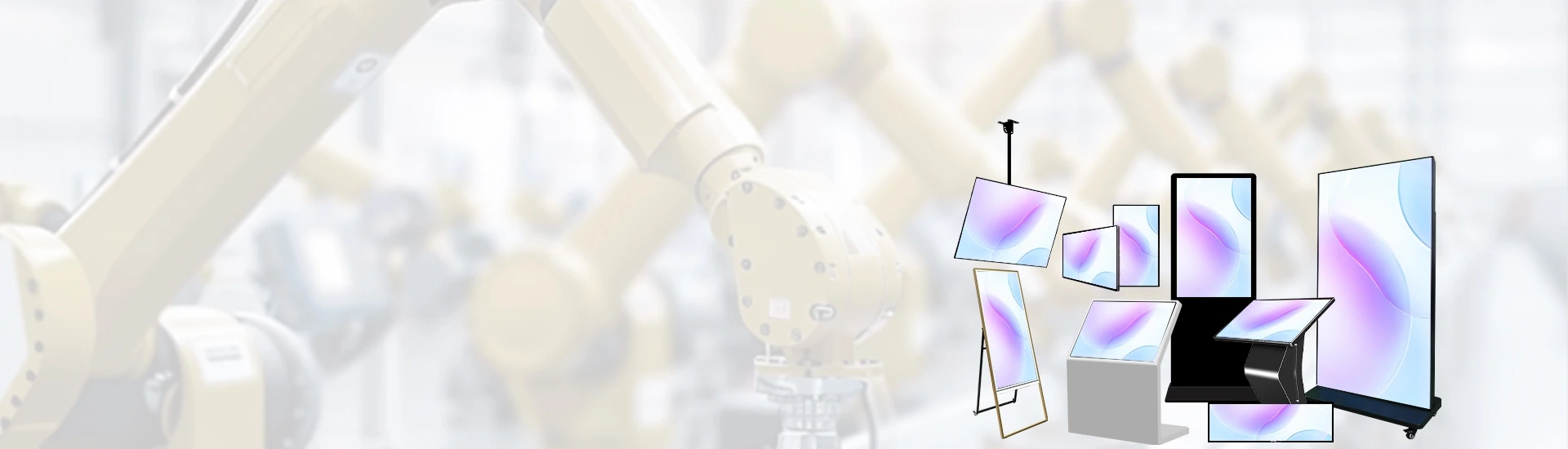
Traditional printed menus and static light boxes force B2B food-service operators into a costly cycle: every price change triggers a reprint, every promotion rollout depends on manual labour, and every new store opening introduces another opportunity for brand inconsistency. For chains managing dozens or hundreds of locations, these friction points compound into a measurable operational drain.
Digital menu signage replaces that static infrastructure with a centrally managed display network that updates in seconds, synchronises pricing across every store, and adapts to dayparting schedules without staff intervention. This guide covers the screen technologies available, content design standards, placement strategy, procurement criteria, and real deployment cases from operators in the United States, United Kingdom, Australia, and beyond.
Digital menu signage is not simply a commercial monitor on a wall. A complete system integrates commercial-grade display hardware, a built-in or external playback terminal, content management software, network connectivity, and optional POS data feeds into one operational pipeline. The distinction matters because B2B buyers who evaluate only the screen specification often discover later that the system layer cannot support multi-store batch updates or automated price synchronisation.
When evaluating offers from different digital menu screens companies, the lowest hardware quote rarely produces the lowest total cost of ownership. Commercial-grade panels with 24/7 duty-cycle ratings and built-in system-on-chip architecture eliminate external media players, reduce failure points, and lower long-term maintenance costs. Consumer televisions used in commercial settings typically develop burn-in within 12–18 months and void manufacturer warranties, erasing the upfront savings of $200–$400 per screen within the first replacement cycle.
Screen selection is the most consequential hardware decision in a digital menu signage deployment. The three dominant categories — LCD, OLED, and outdoor-rated electronic menu signage — serve fundamentally different viewing environments, duty cycles, and budget profiles.
LCD panels dominate commercial menu board deployments because they balance cost, brightness, longevity, and availability across the widest range of indoor environments. Modern commercial LCD displays deliver 350–700 nits brightness for standard indoor counters, with 700–1,500 nits variants available for window-adjacent or brightly lit locations. For most quick-service restaurants, coffee chains, and convenience stores, a 43–55 inch 4K commercial LCD with anti-glare coating and 16/7 duty rating represents the optimal specification.
これらの digital menu screens handle continuous operation without the burn-in risk that affects OLED panels displaying static price columns. The indoor digital signage product range covers display specifications and system configurations designed specifically for restaurant counter and overhead menu applications.
OLED technology delivers perfect black levels, ultra-thin form factors, and colour reproduction that LCD cannot match. For fine-dining establishments, boutique coffee roasters, and premium bakery brands, OLED menu screens create a visual presentation that reinforces the brand's positioning. The trade-off is lifecycle cost: OLED panels have a shorter operational lifespan than commercial LCD, and static menu elements — particularly fixed price columns — require pixel-shifting routines or periodic layout rotation to mitigate burn-in risk.
Outdoor electronic menu signage must survive direct sunlight, rain, dust, temperature extremes, and continuous operation. Drive-thru menu boards typically require 2,500–4,000 nits brightness, IP66-rated enclosures, and operating ranges of -20°C to 50°C. Optically bonded glass reduces glare and maintains readability when the sun angle shifts throughout the day. These installations demand a different procurement checklist: thermal management, anti-reflective treatment, remote monitoring for fault alerts, and a service agreement that covers on-site repair without shipping units back to a warehouse.
| Criteria | LCD Digital Menu Screens | OLED Digital Menu Screens | Outdoor Electronic Menu Signage |
|---|---|---|---|
| Brightness range | 350–1,500 nits | 400–800 nits | 2,500-4,000ニッツ |
| Duty cycle | 16/7 to 24/7 commercial rated | Typically 16/7, burn-in risk with static content | 24/7 with thermal tolerance |
| Best-fit environment | Indoor counter, overhead menu, convenience store | Fine dining, boutique café, premium bakery | Drive-thru, storefront window, outdoor ordering lane |
| Viewing distance | 1–5 metres standard; up to 8 metres for 55"+ | 1–4 metres | 3–10 metres (drive-thru lane) |
| Lifespan concern | Panel degradation over 50,000+ hours | Burn-in risk with static elements | Enclosure seal degradation, anti-glare coating wear |
| Relative TCO | Lowest for indoor deployments | Highest per screen; premium visual payoff | Highest hardware cost; lowest per-location content cost |
| Typical use case | QSR counter, coffee chain, c-store | Fine dining, roastery, bakery | Drive-thru, street-facing storefront |
When comparing offers from multiple digital menu screens companies, request the panel duty-cycle rating, the warranty terms for commercial use, and the availability of remote monitoring. A vendor that supplies only the screen without a CMS platform or installation service will leave the operator to manage integration across two or three additional suppliers — a fragmentation that increases both rollout time and failure risk.
Content design determines whether a digital menu signage investment delivers conversion value or becomes background noise. The standards below reflect what works across high-volume QSR, fast-casual, and coffee-chain environments.
Effective digital menu screens organise information in three layers. The primary layer carries the highest-margin items, combo meals, and core price points — the items the operator most wants the customer to see first. The secondary layer holds product descriptions, promotional badges, and category navigation cues. The tertiary layer displays time-sensitive content: limited-time offers, new product launches, or inventory status messages.
Maintaining this hierarchy across every store requires a locked template system. Indoor digital menu boards deployed with standardised layout templates prevent individual locations from rearranging menu sections or introducing off-brand colours, which is one of the most common sources of brand drift in multi-store estates.
The operational value of digital menu signage increases exponentially when the system connects to the point of sale. POS integration for digital menu boards synchronises pricing, product availability, and inventory status in real time, so a price change at the register flows to the screen without manual entry, and a sold-out item disappears from the display the moment the kitchen marks it unavailable.
Dayparting — the automated switch between breakfast, lunch, dinner, and late-night menus — eliminates the manual content swaps that consume staff time during peak transitions. A properly configured system handles the schedule without intervention, and a central dashboard confirms that every store made the switch at the correct time.
Menu boards in many markets are subject to pricing transparency requirements, allergen disclosure rules, and accessibility standards. Electronic menu signage makes compliance easier to manage centrally: legal disclaimers, allergen icons, and promotional terms can be locked into template footers that stores cannot edit or remove. Multi-language support for tourist-heavy locations and high-contrast modes for accessibility compliance are also easier to implement and audit across a fleet of digital menu screens than across printed alternatives.
The point-of-sale counter is the highest-conversion position for a digital menu screen. Customers standing in the ordering queue are in a decision state, and the screen content directly influences what they order. Overhead menu boards above the counter serve the same function; the choice between counter-height and overhead depends on ceiling height, sightlines, and whether the operator needs the screen visible from the entrance.
Secondary indoor positions include the dining area wall — useful for promoting add-ons and loyalty programmes to seated customers — and the store entrance, where a menu screen can preview the menu and reduce queue-time hesitation.
Drive-thru lanes and street-facing windows require outdoor-rated electronic menu signage with high-brightness panels and weatherproof enclosures. The drive-thru menu board is the primary decision point for a large proportion of QSR revenue, and the screen must remain readable in direct sunlight, rain, and temperature extremes. In the United Kingdom and Ireland, McDonald's deployed approximately 6,850 outdoor digital menu boards across 950 locations, replacing static signage with displays rated for year-round outdoor operation.
B2B procurement of digital menu signage should evaluate four criteria beyond hardware specification: commercial-grade certification (duty cycle, warranty for commercial use), system integration capability (CMS platform, POS compatibility, API availability), service level agreement (response time for on-site repair, spare parts availability, remote diagnostics), and deployment experience (references from comparable multi-location rollouts).
Digital menu board systems that include built-in playback terminals remove the need to source, install, and maintain separate media players — a simplification that reduces both capital cost and failure points across a multi-store estate. When evaluating a digital menu screens company, request the panel duty-cycle rating, the CMS feature set for multi-store batch updates, and the SLA terms for on-site service response.
A phased rollout — pilot in two to three representative locations, validate content templates and POS integration, then scale — reduces the risk of a fleet-wide configuration error. Standardised template libraries lower the design cost per store and prevent brand drift. Central permission structures ensure that only headquarters or approved regional managers can publish content to digital menu screens, while store-level staff retain visibility into what is displayed.
Remote monitoring is the single most important maintenance feature for multi-location digital menu signage. A platform that alerts headquarters when a screen goes offline, a player fails to check in, or a panel reports a thermal warning allows the operations team to dispatch service before the failure affects customer experience. For chains with hundreds of menu screens, this proactive maintenance model reduces the cost of emergency service visits and minimises screen downtime.
Little Caesars, the third-largest pizza chain in the world, deployed cloud-managed digital menu signage across thousands of restaurants in 16 countries. The platform provides centralised content management that allows the brand to push menu updates, promotional campaigns, and pricing changes to every international location from a single dashboard, replacing the fragmented manual processes that had previously varied by market.
KFC deployed digital menu boards across more than 1,000 restaurants in the UK and Ireland, combining indoor counter displays with drive-thru systems under a single integrated programme. The rollout replaced static printed menus across a large and growing network, enabling the chain to update pricing, product availability, and promotional content simultaneously across all locations.
Amped Digital launched Australia's first fully integrated drive-thru digital experience for Grill'd Healthy Burgers, replacing conventional outdoor menu boards with a digital system designed for the specific viewing conditions of an Australian drive-thru lane. The installation addresses the high-brightness, high-temperature requirements of outdoor electronic menu signage while delivering the content flexibility of a cloud-managed platform.
Finnish street-food chain Pretty Boy modernised its Helsinki locations with digital menu boards that mimic the aesthetics of a street food truck while enabling real-time updates and streamlined campaign deployment. The deployment demonstrates how digital menu screens can reinforce a brand's visual identity while delivering the operational efficiency of centralised content management.
These deployments share a common pattern: multi-location operators move to digital menu signage not for the screen technology itself, but for the operational control it enables — consistent pricing, rapid promotion deployment, and a single source of truth for what every customer sees.
Digital menu signage delivers measurable operational value to B2B food-service operators: faster price updates, consistent brand presentation across every location, reduced reprint and labour costs, and the data integration that connects menu display to POS reality. The technology decision — LCD, OLED, or outdoor-rated — should follow the environment and the brand positioning, not the other way around.
For single-location operators, a commercial LCD with a cloud CMS and a standardised template provides the highest return on investment. For chains deploying across multiple markets, the priority shifts to platform-level capabilities: POS integration, remote monitoring, permission management, and an SLA that covers on-site service. For service providers and AV integrators, the value proposition is a standardised hardware-and-software kit that can be replicated across client sites without re-engineering each installation.
Whichever deployment path applies, the procurement criteria remain consistent: commercial-grade hardware, a CMS that supports multi-store batch operations, documented service response times, and a vendor with references from comparable deployments. Contact the Qtenboard team to discuss system specifications for your deployment.
Planning a multi-location digital menu signage rollout? Review the complete system architecture and procurement checklist.
Request a Deployment Consultation
 JP
JP
 EN
EN  AR
AR  DAN
DAN  IT
IT  ARM
ARM  FIN
FIN  SWE
SWE  NOR
NOR  MAY
MAY  NL
NL  TH
TH  KOR
KOR  PL
PL  RU
RU  PT
PT  SPA
SPA  FRA
FRA  DE
DE  CHT
CHT 