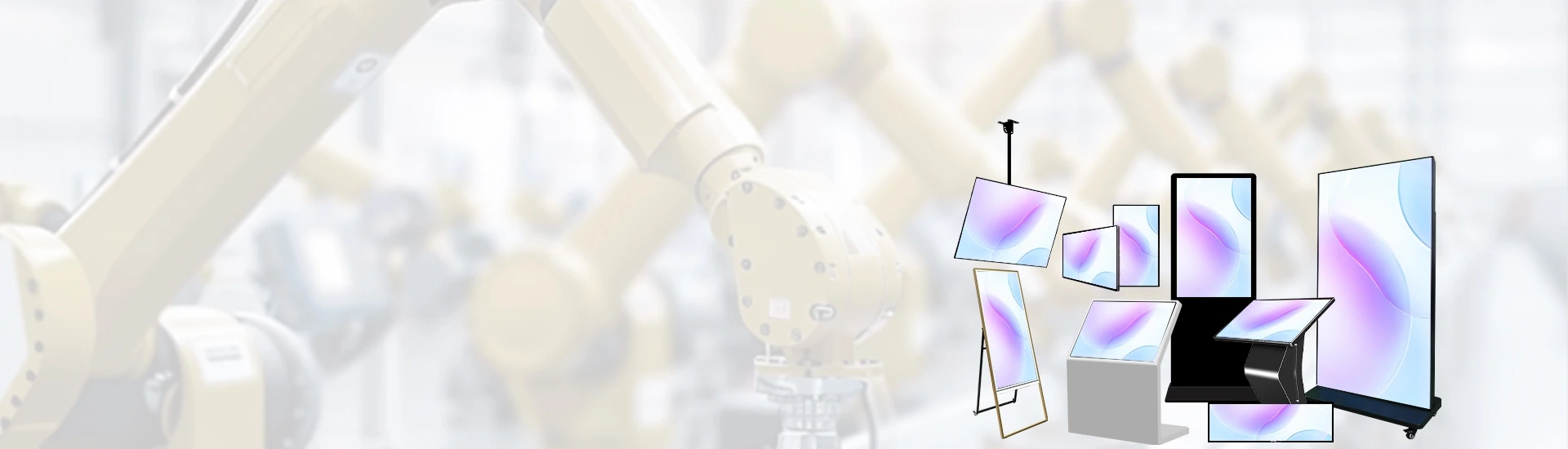
Across North America and Europe, restaurant and retail operators face three converging pressures: rising labor costs, chronic queue bottlenecks at peak hours, and menu content that becomes outdated faster than it can be reprinted. In the United States, the restaurant industry's labor cost ratio has climbed steadily, prompting chains from Steak 'n Shake to Wendy's to accelerate self-service technology adoption. In the UK, operators like Popeyes and Chopstix are deploying digital menu kiosks alongside dynamic menu boards to reduce reliance on counter staff.
This guide is written for chain restaurant operators, franchisees, equipment procurement managers, and IT decision-makers evaluating kiosk vs menu board deployment. You will find concrete cost ranges, integration requirements, real deployment cases from four countries, and a practical framework for choosing — or combining — these two technologies.
A digital menu board is a display screen — typically wall-mounted or hanging — that shows menu items, pricing, promotional content, and branding in a dynamic, remotely managed format. Unlike static printed menus, digital menu boards can update pricing in seconds, schedule daypart-specific menus (breakfast, lunch, dinner), and run multimedia promotions. They are display-first devices: customers read them, but do not interact with them to place orders.
Qtenboard's smart digital menu boards are available in 43", 49", and 55" sizes with 4K resolution, multi-screen synchronization, and offline playback support. Their centralized CMS allows multi-location chains to push menu updates from headquarters to hundreds of screens simultaneously — a capability that proved decisive for a U.S. fast-food chain managing 100+ branches.
Adigital menu kiosk — also called a self order kiosk O menu kiosk — is an interactive terminal that allows customers to browse the menu, customize items, place orders, and complete payment without staff assistance. Unlike a menu board, a kiosk is transaction-oriented: it connects to the POS system, sends orders to the kitchen display system (KDS), and processes payments through integrated gateways.
According to industry research, self-service kiosks reduce queues, eliminate bottlenecks, and give customers greater control over the ordering process. In high-traffic retail and restaurant deployments, case studies consistently show 20–50% ROI in the first year, with payback periods of 6–18 months depending on order volume and upsell effectiveness.
| Dimension | Digital Menu Board | Digital Menu Kiosk |
|---|---|---|
| Core function | Display and marketing | Self-service ordering and payment |
| Interaction model | Passive / non-interactive | Fully interactive (touchscreen) |
| Primary goal | Attract, inform, drive traffic | Convert, upsell, reduce labor |
| Hardware cost (per unit) | $500–$2,000+ | $1,500–$5,500 |
| Software cost | $0–$80/month per screen | $50–$289/month per device |
| POS integration | Not required | Required (Toast, Square, Clover, NCR, etc.) |
| Payment gateway | Not applicable | Required (PCI-DSS compliant) |
| KDS integration | Not applicable | Required for order routing |
| Deployment timeline | 1–2 weeks per location | 3–6 weeks per location (including integration) |
| Maintenance frequency | Low (content updates only) | Medium (hardware, software, payment systems) |
| Typical ROI timeline | 3–6 months | 6–18 months |
| Data collection capability | Basic view metrics | Full order data, customer behavior, upsell analytics |
| Best-fit traffic level | Low to moderate | Moderate to high (peak queues) |
A menu board sells the item; a kiosk takes the order. This distinction is fundamental. A menu board's job is to make the food look appealing and communicate pricing clearly. A kiosk's job is to complete a transaction — including item customization, payment, and receipt generation. Confusing these roles leads chains to overspend on the wrong screen first.
Adigital menu kiosk cannot function without POS integration. The kiosk software must communicate with the POS to transmit orders, update pricing, and sync inventory. It must also integrate with the payment gateway and, in most cases, the kitchen display system. Before purchasing any kiosk, verify that your existing POS is on the vendor's supported integration list. Leading platforms like GRUBBRR support 93+ POS systems including Toast, Square, Clover, NCR, and PAR.
The sticker price of a kiosk is only part of the equation. Total cost of ownership includes hardware, software subscription, POS integration fees, payment processing fees, installation, staff training, and ongoing maintenance. For a 3-kiosk deployment in a QSR, the all-in first-year cost typically ranges from $12,000 to $30,000, depending on the configuration and integration requirements. A digital menu board, by contrast, has a significantly lower entry point and ongoing cost structure.
Kiosks require more planning than passive screens. Durability (vandal-resistant glass, spill protection), accessibility compliance (ADA in the U.S., similar standards in the UK and EU), and software complexity all add to deployment overhead. Budget an additional $500–$2,000 per unit for accessibility and durability features. Menu boards, by contrast, can often be deployed in 1–2 weeks with minimal site preparation.
A menu board broadcasts. A kiosk collects. Every order placed at a self order kiosk generates data: which items are viewed, which are added to cart, which upsell prompts convert, and what the average order value is. This data can be used to optimize the menu board's featured items, refine pricing strategy, and identify high-margin products for promotional focus. For multi-location chains, this feedback loop is one of the highest-value outputs of kiosk deployment.
Steak 'n Shake implemented structural automation — including self-service kiosks and digital menu boards — as a business survival strategy to combat rising labor costs, inconsistent service, and declining traffic. In many locations, kiosks became the default ordering interface, with traditional cashier stations reduced or removed entirely.
Key outcomes: Labor compression (fewer cashiers per shift), higher order accuracy (customers enter orders directly), improved throughput during peak hours, and consistent upselling through guided UI prompts. Staff were reassigned to food preparation and fulfillment, where speed and consistency matter most.
Alongside kiosks, Steak 'n Shake expanded its use of digital menu boards to regain control over pricing, promotions, and menu complexity — demonstrating the combined deployment model in practice.
Pan-Asian QSR chain Chopstix Group deployed a full suite of digital solutions at a new store launch: two K27 double-sided kiosks for self-service ordering and four 43" digital menu boards for in-store communication. The content management system enabled the team to maintain consistency across multiple sites while focusing on productivity.
Key outcomes: Enhanced customer journey from entrance (menu boards) to ordering (kiosks), streamlined operations, and seamless installation delivered with minimal disruption to the store's opening schedule.
Australian seafood restaurant Famous Fish by Costi, a family-owned premium seafood retailer, adopted self-service touch screens combined with dynamic menu boards to handle high store traffic with robust, user-friendly technology. The deployment increased brand awareness and boosted customer spend.
Key outcome: At the Fountain Gate franchise, the average transaction value was 28.7% higher when customers had autonomy and time to consider their purchase and order themselves in-store.
Pizza Hut in Spain and Portugal deployed kiosk ordering systems to reduce counter queues and increase average check size. The kiosks were integrated with the existing POS infrastructure and configured with automated upsell prompts.
Key outcomes: 30% queue reduction, 21.9% increase in upsell conversion, E 5% increase in average check. The deployment demonstrated that kiosk ROI in European QSR environments can be achieved within the first year of operation.
Decathlon France, one of Europe's largest sports retailers, transitioned from Windows-based terminals to Android CMS kiosks across 60 stores. The goal was to streamline in-store promotions and self-checkout operations. After the upgrade, average kiosk response speed improved by 35%, while CMS-based content updates reduced manual workload by 50%. The Android system also allowed Decathlon to integrate loyalty programs and payment gateways directly.
A U.S. fast-food chain previously updated menus and promotional videos manually at each location, causing delays and errors. After adopting a centralized CMS, the chain could schedule campaigns a month in advance and push updates from headquarters to all stores simultaneously. When launching a new burger, the advertisement went live across 100+ branches with a single update — new product sales surged by 30%.
The most effective deployment model for chain brands is not choosing between a digital menu kiosk and a kiosk vs menu board — it is deploying both in a coordinated customer journey. This approach is frequently overlooked but delivers the highest ROI for multi-location operators.
Position digital menu boards at the entrance, waiting area, or drive-thru to showcase high-margin items, limited-time offers, and brand content. The board's role is to shorten decision time and create desire before the customer reaches the ordering point.
Place self order kiosks in the ordering zone so customers can immediately act on the menu board's promotional cues. The kiosk handles customization, payment, and receipt generation — reducing staff involvement in the transaction to near zero.
Manage menu content, pricing, and promotional schedules from a single CMS that pushes updates to both menu boards and kiosks simultaneously. This eliminates the risk of pricing inconsistencies between what the board displays and what the kiosk charges. Qtenboard's centralized CMS supports multi-device content delivery, layout editing, emergency push, and role-based access — enabling chains to maintain brand consistency across hundreds of locations. Learn more about how digital signage systems work to understand the CMS architecture behind multi-location deployments.
Use order data collected by kiosks — item views, cart additions, upsell acceptance rates, and average order value — to optimize the menu board's featured items and promotional rotation. A dish that converts well at the kiosk should be promoted more prominently on the board. A high-margin item with low kiosk visibility should be repositioned.
Is a digital menu kiosk necessary for small cafes?
For small cafes with low-to-moderate foot traffic and limited budgets, a digital menu board is often sufficient. A kiosk becomes justifiable when peak queues exceed 5–10 minutes, labor costs are a significant burden, or the brand needs order-level data for menu optimization. Start with a menu board; upgrade to a kiosk when traffic volume and labor constraints create a clear ROI case.
Can a digital menu board sync content with a self order kiosk?
Yes, and this is the recommended approach for chain brands. A centralized CMS can push the same pricing, promotional content, and menu updates to both menu boards and kiosks simultaneously. This eliminates pricing inconsistencies and ensures that what the customer sees on the board matches what they see on the kiosk. Most commercial CMS platforms used for digital signage support multi-device content scheduling and real-time updates.
What is the typical ROI timeline for deploying a menu kiosk?
Industry data indicates that most restaurant kiosk deployments achieve payback within 6–18 months, depending on order volume, average check size, and upsell effectiveness. In high-traffic QSR environments, payback can be as fast as 6 months. A sample ROI model with $3,500–$7,000 kiosk cost and $2,000–$8,000 monthly lift per store shows payback in 6–18 months.
How much does it cost to integrate a digital menu kiosk with an existing POS system?
POS integration costs typically range from $500 to $2,000+ per location, depending on the POS platform and whether the kiosk vendor has a pre-built integration or requires custom API development. Toast, Square, Clover, and NCR Aloha have well-established kiosk integration ecosystems, often resulting in lower integration costs. Proprietary or legacy POS systems may require custom middleware, increasing both cost and timeline.
What is the difference between a digital menu kiosk and a self order kiosk?
The terms are largely interchangeable. Both refer to an interactive terminal for self-service ordering and payment. "Digital menu kiosk" emphasizes the menu browsing and display aspect, while "self order kiosk" emphasizes the transactional, self-service function. In practice, they describe the same hardware category.
Can a digital menu board work without a POS system?
Yes. A digital menu board is a display device and does not require POS integration. It needs a content management system to schedule and update content, but it does not need to communicate with the POS. This makes menu boards significantly easier and cheaper to deploy than kiosks.
How many self order kiosks does a restaurant need?
A common planning benchmark is 1 kiosk per 50–75 peak-hour transactions. For a QSR with 200 peak-hour orders, 3–4 kiosks are typically appropriate. The exact number depends on average transaction time (typically 60–90 seconds per order) and the desired queue length. Start with a pilot of 2–3 units and scale based on measured throughput.
Talk to our solution team about your restaurant or retail environment. We help operators across the U.S., UK, Europe, and Australia plan, integrate, and deploy self-service kiosks and digital menu boards.

 IT
IT
 EN
EN  AR
AR  DAN
DAN  ARM
ARM  FIN
FIN  SWE
SWE  NOR
NOR  MAY
MAY  NL
NL  TH
TH  KOR
KOR  PL
PL  JP
JP  RU
RU  PT
PT  SPA
SPA  FRA
FRA  DE
DE  CHT
CHT 