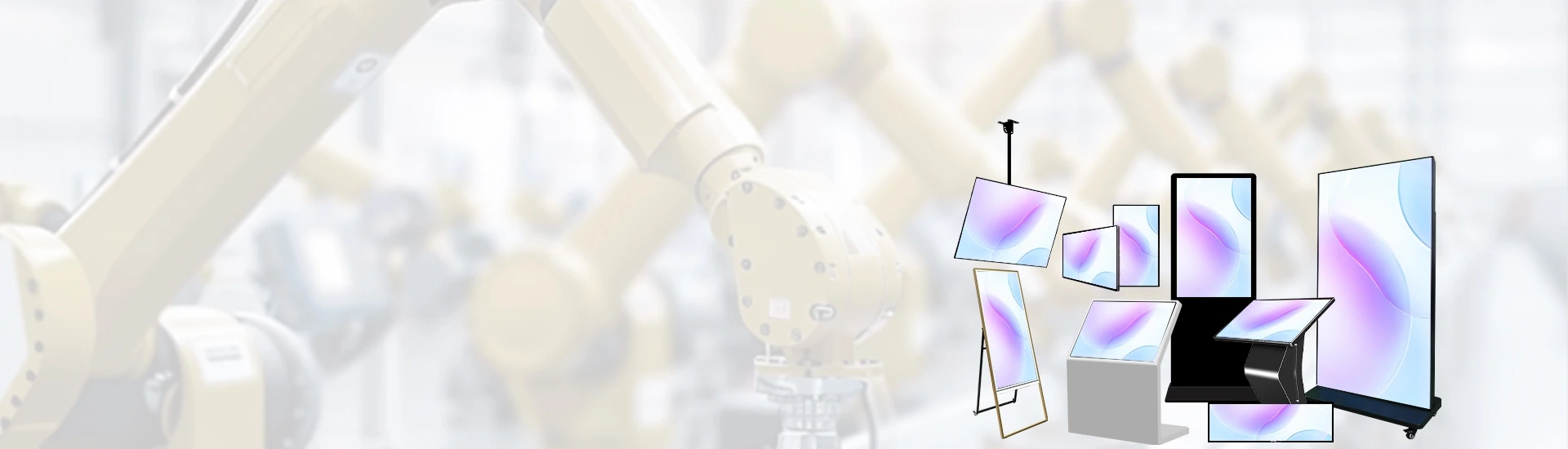
Acustomized OEM digital menu board is a commercial display system built to your brand specifications—hardware, software, and enclosure—manufactured by a menu board manufacturer and delivered under your label. Unlike off-the-shelf displays, OEM production gives B2B buyers control over panel brightness, CMS white-labeling, I/O configuration, and certification scope before a single unit ships.
Global demand for digital menu boards reached US$782 million in 2025 and is projected to hit US$1.33 billion by 2032, growing at a 7.8% CAGR[reference:0]. For distributors, franchise groups, and signage integrators, this growth signals a clear sourcing opportunity—but only for buyers who understand the difference between a standard display and a true OEM program.
B2B procurement teams frequently conflate these three models. The distinction matters because it determines IP ownership, certification responsibility, and how much engineering work the buyer must absorb.
| Malli: | Branding | Customization Depth | Parhaaksi. | IP Ownership | Sertifiointi |
|---|---|---|---|---|---|
| Standard Stock | Factory brand | Low (color, packaging) | Small-batch trials, resellers | Factory | Factory-held |
| OEM. | Buyer brand | Medium-High (hardware + logo) | Brand owners, chain operators | Buyer | Shared / negotiable |
| ODMName | Buyer brand | High (buyer-spec design) | Fast market entry, unique designs | Negotiable | Factory-led |
| White Label | Buyer brand | Software/UI only | CMS platforms, distributors | Buyer (software) | Factory-held |
For a deeper technical comparison of display hardware and software stacks behind these models, the complete B2B guide to digital menu boards covers the full component architecture.
Once the model type is clear, the next decision is the OEM menu board engagement structure. There is no single right answer—the right model depends on order volume, engineering resources, and go-to-market speed.
You provide: brand identity, software direction, packaging specs.
Factory provides: hardware engineering, certification, production.
Typical MOQ: 50–200 units.
Best for: established brands with in-house software teams.
You provide: market requirements, target price, brand assets.
Factory provides: industrial design, hardware, firmware, CMS.
Typical MOQ: 100–500 units.
Best for: distributors entering a new market quickly.
You provide: your CMS brand and customer base.
Factory provides: de-branded software, hardware, updates.
Typical MOQ: 10–50 units.
Best for: SaaS platforms and signage integrators.
You provide: long-term volume commitments, regional exclusivity.
Factory provides: dedicated production slots, priority R&D, joint certification.
Typical MOQ: Negotiated annual contract.
Best for: multi-region operators and large distributors.
For integrators working with hospitality brands, the deployment patterns documented in digital menu boards for restaurants illustrate how OEM hardware choices affect CMS compatibility and multi-site rollout speed.
Enclosure customization is the first layer most buyers tackle. Common options include:
For a reference configuration, the 43″ commercial digital display supports 1920×1080 or optional 3840×2160 resolution, 2GB RAM + 32GB ROM, and Android/Windows dual-system architecture—a baseline that scales across the 32″–75″ range for OEM programs.
Software is where white label menu board programs create the most differentiation. Buyers typically request:
For software-POS integration patterns relevant to QSR chains, the digital menu board POS integration guide explains the data flow for pricing and inventory sync.
| Kohde | Standard Stock | Custom OEM | Full ODM | White Label |
|---|---|---|---|---|
| MOQ | 1–5 units | 50–100 units | 100–500 units | 10–50 units |
| Sample lead time | 3–5 days | 7–15 days | 15–25 days | 5–10 days |
| Mass production | 10–15 days | 20–35 days | 35–55 days | 15–25 days |
| Certification cycle | Pre-certified | 2–4 weeks | 4–8 weeks | Pre-certified |
| Sample refundable | No | Yes, against order ≥ MOQ | Yes, against order ≥ MOQ | No |
| Tooling/development fee | Ei ole. | Amortized or one-time | Quoted per project | Ei ole. |
Values shown are typical industry ranges. Confirm exact figures with your supplier before quoting to end customers.
For a menu board manufacturer, certification coverage directly determines which markets a buyer can serve. A typical OEM program should support:
| Market | Required Certification | Typical Cycle | Notes |
|---|---|---|---|
| European Union | CE (LVD + EMC), RoHS, REACH | 2–3 weeks | Declaration of Conformity required |
| Yhdysvallat | FCC Part 15, UL (optional) | 3–4 weeks | UL adds cost, often required by insurers |
| United Kingdom | UKCA | 2–3 weeks | Separate from CE post-Brexit |
| Japani | PSE | 4–6 weeks | Mandatory for mains-powered devices |
| Australia/NZ | RCM | 2–3 weeks | Covers EMC and radio |
| Canada | ISED, CSA/ULC | 3–5 weeks | ISED for wireless modules |
Export documentation should include commercial invoice, packing list, HS code classification (typically 8528.59 or 8528.52), and certificate of origin if preferential tariff treatment applies. For a broader view of how digital signage reduces operational overhead across export-heavy markets, the industry news archive documents similar compliance-driven procurement patterns.
Not every factory that quotes an OEM program can actually execute one. Use these verification steps before committing tooling or certification budgets.
For outdoor and drive-thru applications where enclosure durability is critical, the drive-thru digital menu board guide details IP rating requirements and dual-screen linkage configurations that affect manufacturer selection.
For hospitality and QSR operators evaluating total cost of ownership, the kiosk and digital signage news archive tracks how warranty terms and spare-part logistics affect multi-year deployment budgets.
A US barbecue franchise with 30 restaurants deployed cloud-managed digital menu boards to standardize pricing and promotions across franchise locations while allowing local menu flexibility[reference:1].
Relevance to OEM buyers: the chain required franchise-level autonomy within a corporate brand standard—a scenario where white-label CMS permissions and multi-store user roles are the deciding hardware-software fit.
A global fast-food brand digitized 850 UK and Ireland restaurants, installing digital menu boards in every store with 5 screens per location (primarily 47″ commercial panels), powered by dedicated NUC PCs[reference:2].
Relevance to OEM buyers: large-scale rollouts demand factory capacity for consistent panel supply, uniform firmware versions, and certification coverage across both UKCA and CE jurisdictions.
An Australian QSR operator used a cloud-based CMS to centrally manage digital menu boards and promotional content across its Bucking Bull and Skewerz Kebabz locations, standardizing brand presentation while retaining per-brand menu logic[reference:3].
Relevance to OEM buyers: multi-brand operators need a white-label CMS that supports template separation by brand while sharing the same hardware fleet—a common OEM software requirement.
A 200-location bakery chain spent US$12,000 and 2 days reprinting menus for every price change. After deploying 43″ 4K displays with cloud CMS, store managers update prices in under 5 seconds[reference:4].
Relevance to OEM buyers: the ROI case here is operational, not just visual. OEM buyers should prioritize CMS update speed and offline playback reliability in their factory specification.
A European bakery chain operating 200 locations in Germany transitioned from printed menu boards to cloud-managed digital displays, eliminating recurring reprint expenses and enabling daypart-based menu switching without staff intervention.
Relevance to OEM buyers: EU deployments require CE and RoHS certification from the factory. Buyers should confirm that the manufacturer holds valid DoC documents for the exact model shipped, not just a generic certificate.
For additional deployment scenarios across retail and hospitality, the kiosk deployment case archive and the digital signage industry news section document similar procurement patterns.
OEM covers hardware branding, enclosure, and I/O configuration; white label typically refers to software de-branding only. Most B2B programs combine both—OEM hardware with white-label CMS.
Typical OEM MOQ ranges from 50 to 100 units for hardware customization. White-label software programs can start as low as 10 units. Some factories accept 20-unit pilot runs before full commitment.
Sample: 7–15 days. Mass production: 20–35 days for OEM. CE/FCC certification: 2–4 weeks. UL or PSE can add 4–6 weeks. Plan 8–12 weeks from PO to certified delivery for a first OEM order.
Yes. White-label CMS platforms typically support 2–8 languages and a single dashboard for 10–10,000+ screens. Confirm API availability for POS or ERP integration before finalizing the software spec.
Some manufacturers offer 20–50 unit pilot OEM runs with reduced tooling fees. This is ideal for validating market demand before committing to a 500-unit order. Ask specifically for a "pilot OEM" program.
Request a live factory tour, 3 recent export references, verifiable certificate numbers, and a CMS demo account. A manufacturer unwilling to provide any of these is a risk.
EU buyers: confirm CE + RoHS + REACH with a valid DoC per model. US buyers: confirm FCC Part 15 and check if UL is required by your insurer or landlord. Ask for the certificate number and verify it independently.
CE, FCC, RoHS, UKCA, PSE, RCM, ISED, UL, and CCC are the most common. The manufacturer should hold pre-existing certificates for the base hardware platform—custom enclosures and panels may require re-certification.
Qtenboard operates a 330,000 m² manufacturing facility with 48-hour aging test protocols, commercial-grade panel sourcing, and a multilingual sales team supporting OEM/ODM programs from 20-unit pilots to 10,000+ unit rollouts. The digital signage case portfolio documents deployments across North America, Europe, and Asia-Pacific.
For brands evaluating a custom digital menu board program, the digital signage news section provides ongoing coverage of hardware and software developments affecting B2B sourcing decisions.
Request a quote, book a factory video tour, or order a pilot sample. Our team responds within one business day.
Verkkosivusto: www.qtenboardglobal.com

 FIN
FIN
 EN
EN  AR
AR  DAN
DAN  IT
IT  ARM
ARM  SWE
SWE  NOR
NOR  MAY
MAY  NL
NL  TH
TH  KOR
KOR  PL
PL  JP
JP  RU
RU  PT
PT  SPA
SPA  FRA
FRA  DE
DE  CHT
CHT 