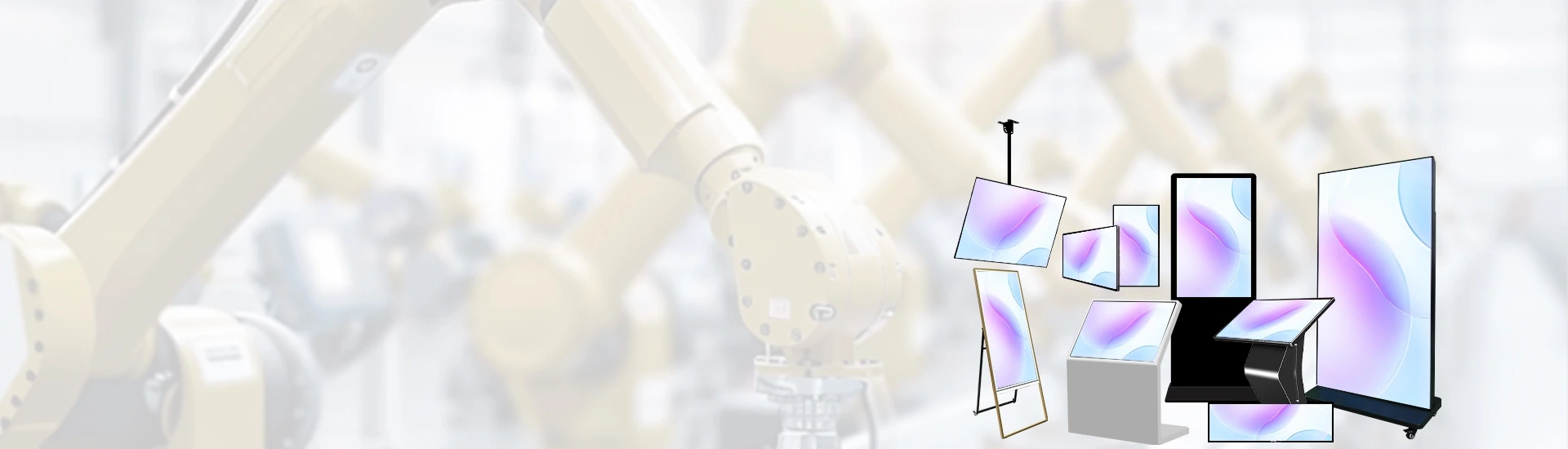
Adigital menu board system is an integrated four-layer solution that replaces static printed menus with dynamic, centrally managed digital displays. Unlike a standalone commercial monitor, a complete digital menu system combines display hardware, a playback terminal, content management software, and network connectivity into one operational pipeline.
The difference between a digital menu board system and a standard commercial display comes down to four capabilities: remote batch content updates, automated time-based menu switching (dayparting), real-time POS price synchronization, and remote device monitoring. A regular commercial display can show a menu image. A digital menu board system can update prices across 200 locations in under five minutes, automatically switch from breakfast to lunch menus without staff intervention, and hide sold-out items the moment inventory runs out.
Jokaan digital menu display system is built on four interdependent layers. Choosing the right option at each layer determines the system's reliability, content capabilities, and total cost of ownership. The sections below follow a decision-first structure: each layer starts with a selection recommendation, then provides technical parameters and common pitfalls.
For any digital menu board system, the screen is the single largest capital expense and the most visible component. Commercial displays are engineered for duty cycles that consumer televisions cannot match.
Using consumer-grade televisions instead of commercial displays is the most expensive mistake in digital menu board deployment. Consumer TVs lack the duty cycle rating for extended daily operation, develop burn-in within 12–18 months, and void manufacturer warranty when used in commercial settings. The upfront savings of $200–$400 per screen are erased by premature replacement costs.
Every Qtenboard digital menu board system features a built-in SoC (System-on-Chip) playback terminal. The SoC is integrated directly into the display, eliminating the need for external media players, extra cables, and separate power supplies. This integrated design reduces failure points, simplifies installation, and lowers total cost of ownership.
With built-in SoC, the display handles content decoding, local caching, and playback natively. Updates are delivered from the CMS over the network and stored locally, so the menu continues playing even during network interruptions. For multi-location deployments, each display operates independently while remaining centrally managed through the CMS.
This architecture is ideal for restaurants of all sizes — from single locations to large chains — because it removes the complexity of sourcing, installing, and maintaining external players. The built-in SoC supports remote reboot, watchdog auto-recovery, and reliable 24/7 operation when paired with commercial-grade panels.
The most significant operational advantage of a digital menu system over printed menus is native POS integration. Modern CMS platforms connect directly to Toast, Square, Clover, Oracle Micros, and similar systems, enabling real-time price synchronization and automatic sold-out item hiding.
When a cashier marks an item as unavailable in the POS, the digital menu board removes it within minutes across every screen. When headquarters adjusts combo pricing, the change propagates to all locations without a single printed insert. This integration eliminates the "double data entry" problem that causes pricing mismatches between the POS and menu boards.
| Malli: | Parhaaksi. | Key Consideration |
|---|---|---|
| Cloud SaaS | Most deployments | Requires reliable internet; automatic updates |
| On-premise | Financial or compliance-sensitive environments | Higher IT overhead; full data control |
| Standalone | Single-location, minimal content | No remote management; manual updates |
Adigital menu service may also include remote monitoring, content design, and managed maintenance — an increasingly common option for chains without dedicated AV staff.
For a digital menu board system delivering standard 1080p content, allocate 5–10 Mbps per screen for content downloads. For 4K content or multi-screen synchronized playback, 15–25 Mbps per screen is recommended. In multi-screen locations, calculate total bandwidth by multiplying per-screen requirements by the number of simultaneous downloads, then add 30% headroom.
The standard architecture for multi-site deployments is local cache plus central distribution: each store downloads content updates to a local player cache, and the central CMS pushes new content on a schedule. This design ensures that a network outage at any single location does not interrupt menu board operation — the player continues serving cached content until connectivity restores.
Content flows through the four layers in sequence: CMS edit → cloud distribution → network transmission → player decoding → screen presentation. A disruption at any layer degrades the entire system. A high-brightness outdoor screen paired with an underpowered SoC produces sluggish transitions. An enterprise-grade CMS without reliable network connectivity cannot push updates. The digital menu board system is only as strong as its weakest layer.
Rather than selecting each component in isolation, the following matrix provides cross-layer configuration recommendations by deployment scale. Each row identifies the most commonly overlooked risk at that scale.
| Scale | Näyttöä | Player | CMS | Verkko | Overlooked Risk |
|---|---|---|---|---|---|
| Single store (1–2 screens) | 43–55" commercial display, 350–500 nits | Built-in SoC | Cloud free/entry tier | WiFi or wired | Using 16/7 panel when operating 18+ hours; no offline cache configured |
| Chain (5–50 stores) | Uniform commercial series, 500–700 nits | Built-in SoC | Multi-site SaaS with tiered permissions | Wired primary + 4G fallback | CMS batch push performance degrades beyond 20 locations; no central template governance |
| Enterprise / Franchise (50+ stores) | Zone-specific selection (indoor + outdoor) | Built-in SoC | Enterprise SaaS with API, SSO, and SLA | Local cache + central distribution | Insufficient API integration depth for POS/ERP; no regional content authorization framework |
Adigital menu system connects to restaurant POS platforms through vendor APIs or middleware. Toast supports multi-location OAuth connections that expose menu data across all locations under one account. Clover integration pulls item names, descriptions, prices, and categories directly from the merchant's inventory. Square connects via access tokens with catalog read permissions.
The integration typically synchronizes: item names, descriptions, current prices, category groupings, and availability status. When an item is marked as 86'd in the POS, the digital menu board can automatically hide it within the configured sync interval.
FDA regulations require chain restaurants with 20 or more locations to list calorie information on menus and menu boards for standard menu items, and to provide additional written nutrition information on request, including total fat, saturated fat, trans fat, cholesterol, sodium, total carbohydrates, fiber, sugars, and protein. This requirement explicitly covers drive-thru boards, digital ordering channels, and kiosks. For chains approaching the 20-location threshold, digital menu boards actually reduce compliance costs because calorie data can be updated centrally rather than reprinted for every location.
ADA accessibility guidelines recommend that digital displays be mounted so the bottom edge is no higher than 48 inches above the floor for wheelchair accessibility. Character height should be a minimum of 5/8 inch (60 pixels), with sans-serif fonts and adequate contrast. For hardware, UL certification (or ETL equivalent) is the standard safety mark in North America, while CE is required for European deployment. FCC Class A compliance applies to commercial digital signage in the United States.
| Komponenti | Typical Range | Tyyppi |
|---|---|---|
| Display (indoor commercial) | $300–$1,400 | One-time |
| Display (outdoor / drive-thru, IP66, 2,500–4,000 nits) | $4,000–$5,500+ | One-time |
| Built-in SoC (included) | $0 (included in display) | Included |
| CMS software | $0–$80 per screen/month | Recurring |
| Asennus | $100–$300 per screen (indoor) | One-time |
| Content design | $0 (templates) – $2,500 (custom) | One-time or ongoing |
| Electricity | $7–$9 per screen/month | Recurring |
A complete indoor digital menu board system costs between $500 and $2,000+ per screen upfront, plus software subscription and recurring electricity. Outdoor drive-thru installations carry a significantly higher hardware cost due to weatherproofing, high-brightness panels, and thermal engineering.
For outdoor drive-thru systems, the purchase price accounts for only 40% to 60% of total cost of ownership over a 5–10 year lifecycle. Electricity, maintenance, replacement parts, and software subscriptions make up the remainder. LED-based outdoor displays have a higher upfront cost — typically 2–3× LCD — but reduce TCO through lower power consumption and longer service life.
NowSignage delivered a centralized, cloud-based CMS powering digital menu boards across thousands of Little Caesars restaurants in 16 countries. The solution was deployed in under six months and replaced a manual, disconnected process with a fully integrated system. The Digitaalinen merkintä platform supports multiple languages and currencies, allowing regional teams to tailor content while marketing launches global campaigns at speed.
Key outcome: Content accuracy improved across all locations; regional flexibility was preserved without sacrificing brand consistency.
The Asian food brand Eat Happy has digitized more than 1,800 shop-in-shop locations across Europe using Connectsignage software, with approximately 20 additional locations going live each month. The deployment spans grocery store partnerships including Edeka, Hit, Kaufland, and Rewe.
Key outcome: Rapid, standardized rollout across multiple retail environments with centralized menu management.
The TORTILLA fast-food group deployed 300 Sony FW-43BZ30L professional displays as digital menu boards across its France and UK locations. This multi-country rollout demonstrates the scale achievable with standardized hardware selection.
Key outcome: Consistent brand presentation across two markets with a single hardware specification.
TRISON delivered digital menu boards across more than 1,000 KFC restaurants in the UK and Ireland, combining in-store displays and drive-thru systems within a single integrated programme. The project addressed the need to move away from static printed menus across a large and growing network.
Key outcome: Unified menu management across dine-in and drive-thru channels at national scale.
A regular commercial display shows content. A digital menu board system adds four capabilities: remote batch updates across all screens, automated dayparting menu switches, POS price synchronization, and remote device monitoring. The display is one layer; the system is the complete pipeline.
A complete indoor setup ranges from $500 to $2,000+ per screen upfront, plus $0–$80 per screen per month in software fees. Outdoor drive-thru displays cost significantly more due to weatherproofing and high-brightness requirements. Installation adds $100–$300 per screen for indoor deployments.
Yes. The player terminal caches content locally. When the network is unavailable, the screen continues playing cached content. When connectivity restores, the player automatically syncs with the CMS and downloads any queued updates.
Yes. Modern CMS platforms integrate natively with Toast, Square, Clover, Oracle Micros, and other major POS systems. Price changes made in the POS propagate to menu boards automatically. Sold-out items can be hidden in real time.
Standardize the display specification across all locations — every display includes a built-in SoC for consistent performance — choose a CMS with proven batch deployment performance at your target scale, and implement wired connectivity with 4G fallback. The selection matrix above provides configuration recommendations for single-store through enterprise deployments.
Outdoor drive-thru displays require a minimum of 2,500 nits; 3,500–4,000 nits is recommended for sunny climates. IP65 is the minimum weatherproofing standard; IP66 or higher is preferred for heavy rain or dust environments. Optically bonded glass with anti-glare etching improves readability under direct sunlight.
Look for a provider that offers remote device monitoring and alerting, content design support, and documented POS integration capabilities. For multi-site deployments, confirm batch deployment performance at your target scale and verify post-sales support SLAs. Qtenboard provides customized selection consultation for deployments of any scale.
Adigital menu board system is a four-layer architecture where each component amplifies or constrains the others. The display determines visibility and durability. The player determines reliability and content capability. The CMS determines operational efficiency and POS integration depth. The network determines how quickly changes reach every screen.
For single-location operators, the lowest-risk path is a commercial display with built-in SoC and a cloud CMS on a free or entry tier. For chains and franchise networks, the investment shifts toward enterprise CMS with API integration and redundant network architecture. In every case, the selection should start with the operational requirement — POS sync, dayparting, remote management — and work backward to the hardware and software that support it.
Ready to specify the right digital menu board system for your deployment scale?
Request a Custom Configuration
 FIN
FIN
 EN
EN  AR
AR  DAN
DAN  IT
IT  ARM
ARM  SWE
SWE  NOR
NOR  MAY
MAY  NL
NL  TH
TH  KOR
KOR  PL
PL  JP
JP  RU
RU  PT
PT  SPA
SPA  FRA
FRA  DE
DE  CHT
CHT 