Global coffee and tea brands keep expanding their footprint. Multi‑site operations bring new challenges for procurement and operation teams. Traditional printed menus, hand‑drawn posters and manual staff recommendations can hardly keep up with frequent menu revisions, fast new‑product launches, consistent brand presentation across locations, and improved customer ordering experiences. Paper‑based materials create extra labour costs, waste, and inconsistent execution between franchise‑owned and corporate‑run stores.
According to market research reports, the global digital signage for cafes market within food service reached approximately USD 800 million in 2024 and is projected to grow to around USD 1.6 billion by 2034, representing a 7.7% CAGR. Within this space, the digital menu board sub‑market was valued at USD 2.5‑3.0 billion in 2024 and is expected to hit USD 4.0‑5.4 billion by 2032. Industry surveys indicate that roughly 30% of customers admit digital menu board for coffee shops directly influences their ordering decisions. Stores equipped with digital menu boards report an average sales uplift of around 5%. These figures show digital displays have evolved from a nice‑to‑have marketing add‑on into critical infrastructure for foodservice chain expansion.
Data compiled from public reports by Market.us, RiseVision and other industry sources. Figures may vary depending on research methodology, for procurement reference only.
| Business Objective | Digital Solution Value |
|---|---|
| Parantaa asiakaskokemusta. | Clear product visuals, pricing and descriptions shorten customer decision‑making time during peak queue hours. |
| Raise Store Operational Efficiency | Cut labour and material costs associated with printing, replacing and distributing physical posters and menus. |
| Enable Scalable Brand Expansion | Centralised multi‑location content management allows new‑product roll‑outs completed within hours across all connected sites. |
After reading this guide, procurement teams will understand hardware configurations for different cafe & tea shop zones, how to combine digital menu boards, self‑order kiosks and promotional displays, how chains can achieve unified multi‑site management, and key criteria to evaluate long‑term capable cafe digital display solutions vendors.
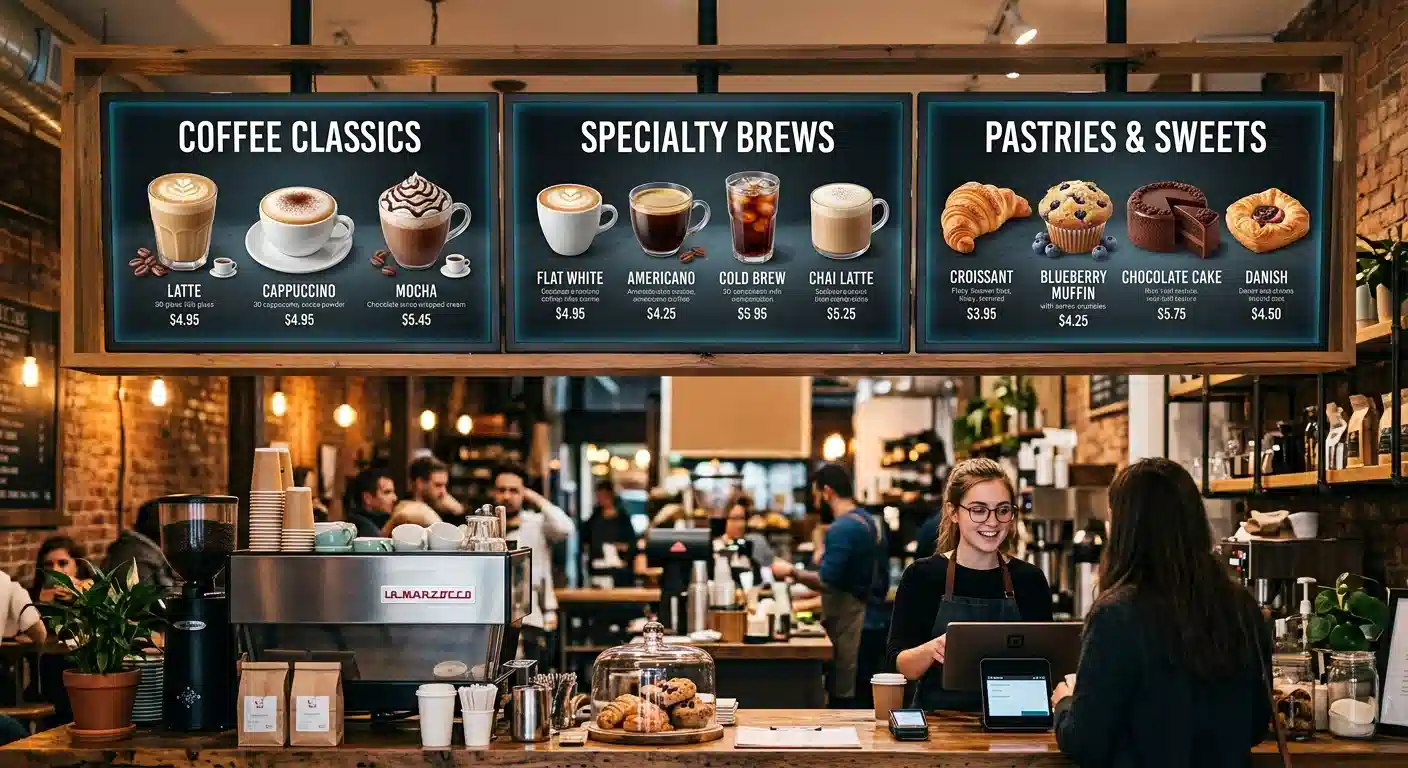
Traditional printed menus suffer from slow update cycles. New‑item promotion heavily depends on staff verbal introduction with limited visual impact. Waiting customers cannot preview offerings while queuing. With digital menu boards, high‑brightness displays and self‑service kiosks, venues can render high‑resolution product imagery, highlight best‑sellers, emphasise seasonal limited‑edition drinks and flexibly switch combo promotions. These improvements shorten decision time, boost exposure for new SKUs and drive upsell and cross‑sell revenue opportunities.
Printing new menus for price adjustments and re‑printing posters for every marketing campaign creates recurring material and labour expense. Maintaining identical content across dozens of stores becomes difficult or impossible with physical materials. With a cloud‑based CMS content management system, headquarters can remotely push content updates to domestic or global store networks, while permitting region‑specific customised messaging. This capability delivers exceptional value for multi‑unit coffee brands, franchised tea outlets and geographically dispersed operators.
For brands operating dozens or hundreds of locations, a robust tea shop digital signage system enforces consistent brand visuals, synchronises new‑product launches and aligns marketing campaign timelines across territories. It mitigates inconsistent local execution, a frequently underestimated pain point during rapid chain growth.
Different store zones serve distinct operational purposes, requiring matching hardware specifications. Below we break down three core zones: ordering counter area, storefront & window exhibition area, and high‑speed self‑order zones.
Placement: Above cashier counters, service windows, back‑walls behind service desks. Digitaaliset valikkolevyt are primary hardware replacing printed menus and handwritten price lists.
Dynamically showcase coffee, tea lines, desserts and meal bundles with rich visuals far exceeding printed paper quality.
Instantly toggle breakfast combos, seasonal specials, limited‑time offers and top‑seller recommendations.
Visual merchandising promotes high‑margin items and upgrade combos to lift average order value across customer transactions.
| Parametrit | Recommended Specification |
|---|---|
| Näytön koko | 43‑65 inch |
| Tarkkuus | Full HD / 4K |
| Operation Duty | 16/7 or 24/7 commercial grade |
| Toimintajärjestelmä | Android / Ikkunat |
| Management Mode | CMS remote management, headquarters content distribution supported |
Storefront environments cannot rely on one‑size‑fits‑all hardware. Entrance, window display, waiting lounge and interior wall spaces each have unique requirements, requiring matched hardware selections rather than generic panels.
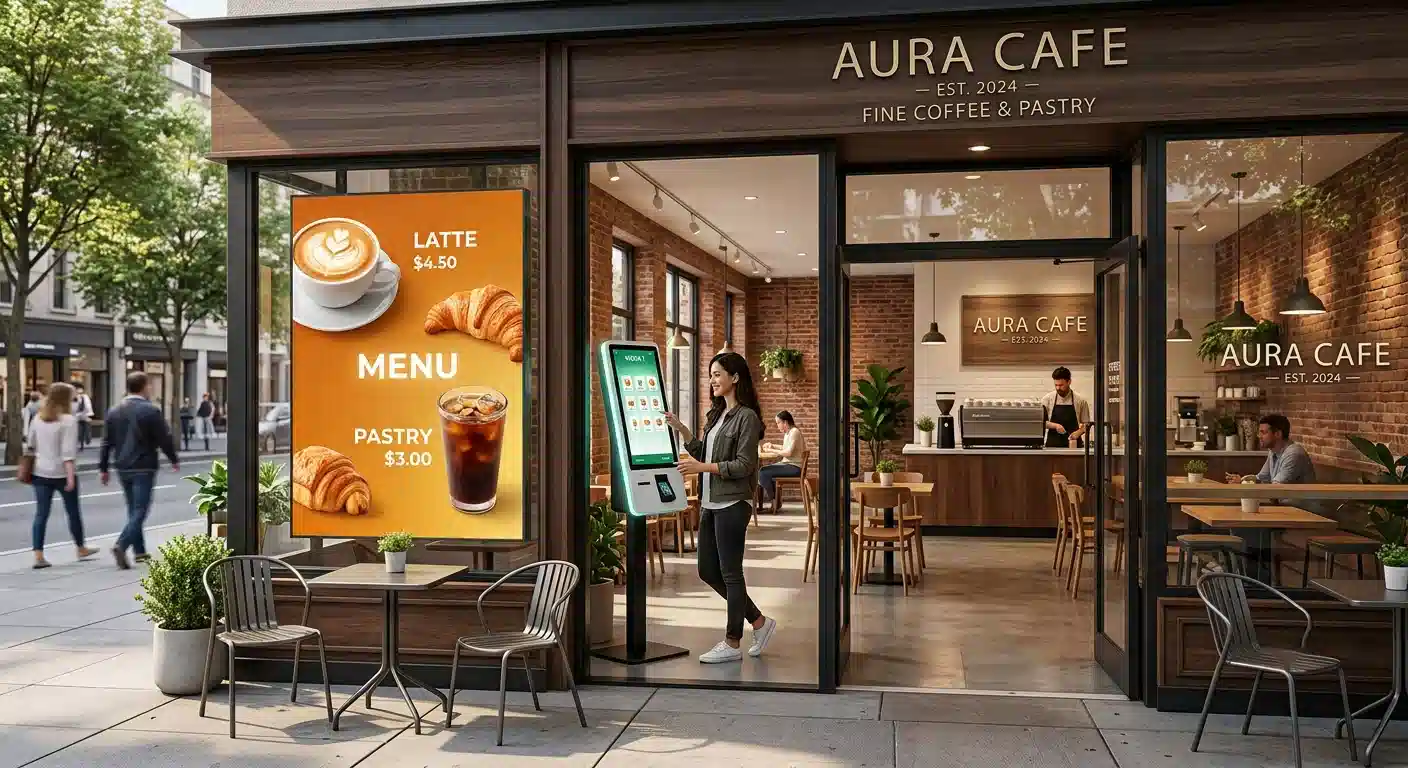
Store entrances deliver the first brand impression for passers‑by, with high footfall and demand for flexible placement or storage during off‑hours. Foldable freestanding digital kiosks require no permanent mounting. They can be deployed during opening hours and folded away after closing. Use them for brand storytelling, beverage craftsmanship clips, seasonal drink promotions and limited‑time discounts to strengthen in‑store atmosphere.
Window installations face strong ambient daylight and direct sunlight. Ordinary commercial screens wash out and lose readability under bright external light. This location demands dedicated high‑brightness window displays with elevated nit performance to remain legible under daylight conditions. Deploy them for new‑product campaigns, brand creative visuals and time‑limited promotions to capture pedestrian attention from street‑side. For window‑facing positions, select high‑brightness panels rated 1500‑3000 nits.
Wall‑mounted commercial displays are widely used within waiting zones. Dynamic video loops, product animations and brand narratives build immersive atmosphere, communicating brand stories and product craftsmanship while guests wait for orders.
| Parametrit | Recommended Specification |
|---|---|
| Näytön koko | 43‑75 inch |
| Mounting Style | Wall‑mount / Foldable freestanding mobile unit |
| Kirkkaus | 500‑700 nits general indoor; 1500‑3000 nits for window‑facing screens |
| Duty Cycle | 24/7 kaupallinen toiminta |
| Verkko | WiFi / LAN wired ethernet |
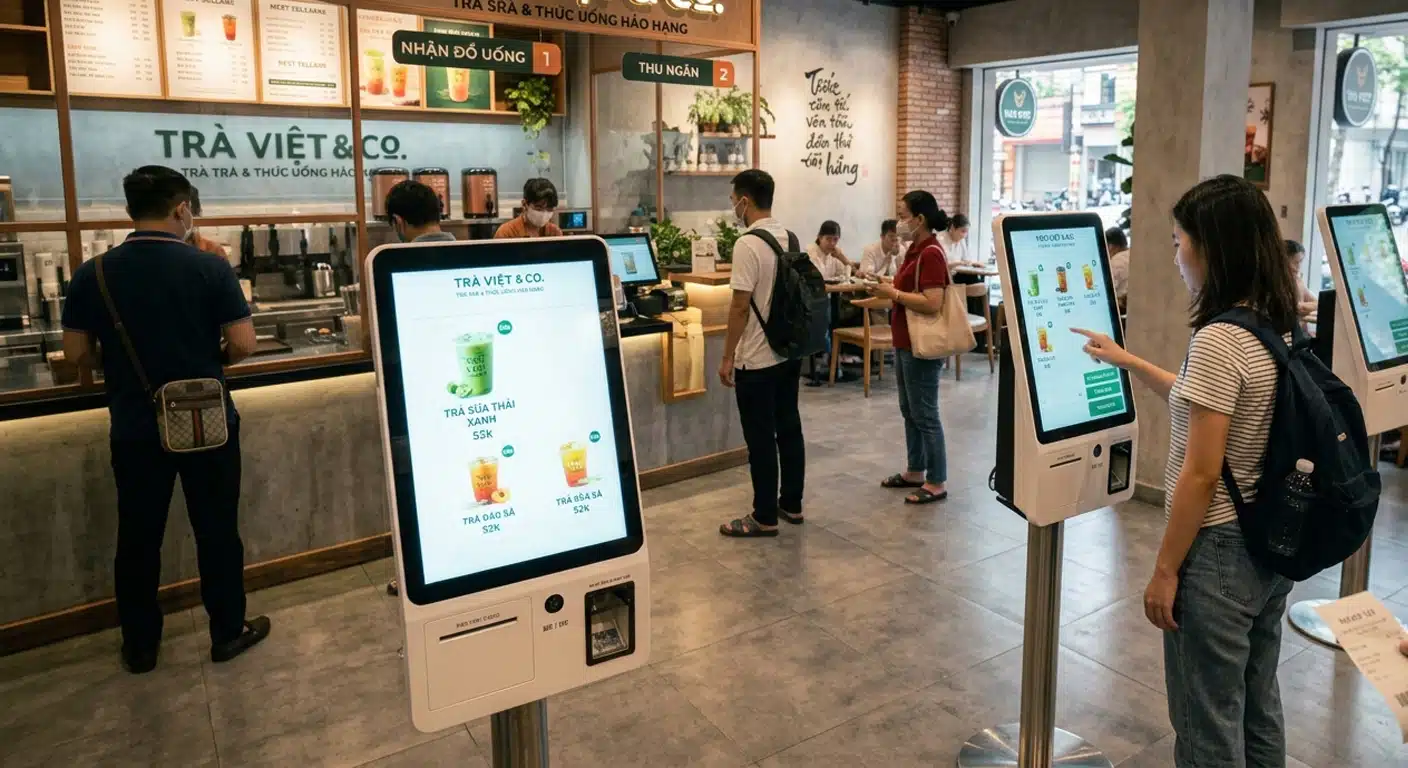
Placement: Peak‑time queue areas, quick pick‑up zones, large‑format coffee chain outlets. Two complementary hardware types apply here: self ordering kiosk for cafes for queuing guests, plus counter‑side assisted ordering terminals.
Positioned within heavy‑traffic queue zones for parallel ordering. Reduce cashier workload; customers customise drink specifications, add‑ons and combo selections independently, cutting overall queue waiting duration.
Installed at cashier counters supporting hybrid staff‑assisted and self‑checkout workflows, ideal for lower‑footfall venues prioritising human‑touch service experience.
Self‑order hardware only delivers real‑world efficiency gains when properly integrated with existing store POS infrastructure rather than operating as isolated siloed devices. Procurement teams must verify these key integration capabilities:
| Parametrit | Recommended Specification |
|---|---|
| Näytön koko | 21.5‑32 inch |
| Kosketusteknologia | 10‑point capacitive touch |
| Toimintajärjestelmä | Android / Ikkunat |
| Peripherals | Payment module / receipt printer / barcode scanner, POS system integration ready |
| Operating Environment | Indoor commercial retail environment |
Procurement teams should confirm long‑term stable supply of selected SKUs, hardware consistency across production batches, and vendor capacity for cross‑border delivery. Mixed hardware models inflate ongoing maintenance expenses and complicate content adaptation for different display resolutions and performance levels.
A capable CMS platform must support headquarters‑level global content distribution, regional‑level differentiated marketing scheduling, time‑based playback scheduling, plus remote real‑time device health monitoring. This enables operators to manage hundreds of store endpoints as one unified ecosystem instead of hundreds of independent disconnected displays.
For chains enforcing strict brand VI guidelines, custom enclosure colour, non‑standard dimension requirements, branded boot‑up splash screens and tailored software adaptation are frequently overlooked procurement factors that directly impact in‑store visual outcomes.
Selecting a vendor is not only about hardware price quotations. It is choosing a long‑term technical and project partner capable of supporting your brand’s multi‑year expansion roadmap. Below are detailed evaluation dimensions procurement teams should examine during vendor screening, including practical questions you can raise during technical communication.
Verify real‑world reference projects within coffee and tea verticals. Generic commercial display vendors often lack deep understanding of foodservice operational realities: peak‑hour traffic patterns, frequent menu revision cycles, franchise‑store governance rules, and mixed corporate‑owned / franchise network requirements. Request case references covering similar store‑count scales, ask for contactable client references when possible, and confirm whether delivered projects include full end‑to‑end deployment or only hardware supply. A qualified vendor should demonstrate comprehension of your pain‑points: fast seasonal menu changes, mixed localised vs global content rules, and high‑volume daily operating hours.
Consumer‑grade televisions cannot substitute for commercial signage hardware. Focus evaluation points include: industrial‑grade panel specification, validated 24/7 continuous‑run qualification, thermal dissipation engineering design suitable for long‑hours retail environments, component selection, and accelerated ageing test procedures inside the factory. Request full technical datasheets, MTBF metrics, and failure‑rate statistics from mass‑produced projects. Clarify component sourcing, spare‑part inventory strategy, and whether core display panels come from tier‑one suppliers. Poor thermal design will cause premature hardware failure in high‑usage cafe locations.
Hardware alone delivers limited value without software interoperability. Confirm the vendor’s integration capacity: native or API‑based POS compatibility, CMS backend capability, payment peripheral integration, kiosk peripheral driver support, and adaptability to your existing third‑party software ecosystem. Clarify responsibilities: who undertakes API development work, whether integration engineering is included within quotation or treated as extra custom engineering cost, and timeline estimates for integration work. Avoid scenarios where hardware performs well out‑of‑box yet cannot connect to your existing store IT stack. Also clarify if the CMS platform is self‑developed or third‑party resold, and who owns ongoing software version upgrade responsibility.
Evaluate supply‑chain practical details: MOQ (minimum order quantity), standard production lead‑time, peak‑season capacity buffer, spare‑parts stocking policy, and cross‑border logistics expertise. For international chains, investigate local after‑sales coverage: overseas service partners, RMA handling workflows, turnaround time for defect replacement, warranty scope definitions, and whether remote diagnostic tools are available. Many hardware manufacturers can ship goods internationally but lack localised support infrastructure, resulting in long repair cycles once devices are deployed abroad. Clarify warranty duration, what failure conditions are covered under warranty, and cost structure for out‑of‑warranty repairs.
Assess the vendor’s custom‑engineering bandwidth: mechanical enclosure modification, custom colours, special non‑standard dimensions, branded boot‑up screens, pre‑loaded brand assets, and Android system firmware customisation. Understand custom‑project MOQ thresholds, sample development lead‑time, NDA policy for brand‑sensitive VI assets, and additional non‑recurring engineering (NRE) charges. This factor becomes essential for premium chains pursuing unified in‑store visual identity across global locations.
Review commercial terms thoroughly: pricing tier structure linked to order volume, payment terms, sample‑testing policy, acceptance testing criteria for mass goods, inspection options before shipment, and change‑order management rules for project adjustments. Discuss project execution workflows: pilot‑sample validation process, mass‑production quality‑control procedures, documentation deliverables including user manuals and installation guides, and dedicated project‑manager allocation for large‑volume orders. Vendors with weak project management may cause schedule slippage during multi‑location roll‑out phases.
Project Background:
A European coffee chain operating more than 80 corporate and franchise stores across Germany and the Netherlands was looking to modernize its in-store communication system.
Previously, each location relied on traditional printed menus and manually updated promotional materials. This created several operational challenges, including:
The brand required a scalable digital signage solution that could support centralized content management while maintaining consistent customer-facing experiences across all stores.
Deployment Solution:
A standardized digital menu board solution was deployed across the entire store network, including:
The deployment followed a phased rollout approach to ensure hardware consistency, installation efficiency, and smooth adoption across corporate and franchise stores.
Deployment Solution:
Reduced new menu update cycles from several days to a few hours, enabling faster seasonal product launches and promotional campaigns
Achieved centralized brand content management across 80+ locations, ensuring consistent visual communication across corporate and franchise stores
Reduced dependency on printed marketing materials, lowering recurring replacement and distribution costs
Established a scalable digital signage infrastructure to support future store expansion across European markets
Project Background:
A rapidly expanding tea beverage chain headquartered in Ho Chi Minh City, Vietnam, was facing operational challenges caused by increasing customer traffic across its retail locations.
During peak business hours, traditional counter-based ordering created several issues:
The company was seeking a self-service ordering solution that could improve customer flow while integrating seamlessly with existing store operations.
Deployment Solution:
A self-ordering kiosk solution was deployed across selected high-traffic store locations as part of the brand’s digital transformation strategy.
The deployment included:
Customer ordering
→ Payment confirmation
→ Order transmission to kitchen/bar preparation system
The solution was designed with a scalable hardware architecture, allowing the tea chain to replicate the deployment model across additional stores during future expansion phases.
Deployment Solution:
Selecting a vendor means selecting a long‑term service ecosystem. Below are deliverable capabilities Qtenboard provides for coffee‑shop and tea‑brand digital signage projects.
On‑site scenario assessment advice, hardware‑selection consultancy and free sample‑unit testing service. Support procurement teams to define precise hardware configurations for ordering counters, entrances, windows and queue zones based on store size, foot‑traffic volume and site layout, lowering project trial‑and‑error risk.
Support custom dimension, mechanical enclosure redesign, brand‑LOGO and boot‑screen customisation plus tailored software adaptation to satisfy strict brand VI visual standards for chain operators.
Products hold international certifications including CE, FCC, RoHS. Manufacturing facility certified under ISO9001 quality‑management system, complying with market‑entry requirements for Europe, Southeast Asia, Middle‑East and other major territories.
Maritime and air‑freight options available. Support trade terms including FOB, CIF. Proven logistics experience delivering bulk shipments to Europe, Southeast Asia, Middle‑East and other regions.
Self‑owned production facility with complete SMT assembly, final integration and accelerated ageing‑test production lines. Capable of fulfilling orders ranging from prototype samples up to multi‑thousand‑unit mass‑volume projects with stable quality consistency.
Direct factory‑to‑buyer sales model eliminating multi‑layer intermediaries. Volume‑based tiered pricing structure delivering favourable unit‑cost economics for large‑scale chain roll‑outs.
2‑3‑year full‑unit warranty coverage. Remote technical support and remote fault‑diagnosis services. Core spare‑parts maintained in inventory to shorten replacement and repair turnaround cycles for overseas clients.
End‑to‑end project support covering sample validation, mass‑production, global logistics, installation guidance and after‑sales maintenance. Support brands from initial pilot‑store evaluation through full‑scale worldwide deployment.
Commercial digital menu boards are purpose‑built for continuous long‑hour operation, high‑brightness performance and CMS remote management within retail environments. Ordinary consumer televisions lack commercial‑grade reliability and management features, and will experience significantly higher failure rates under extended daily operating duty cycles.
Centralised remote content updates and zone‑based permission management are achieved via cloud‑hosted CMS platforms. Headquarters can distribute unified menu content to national or global store networks while permitting authorised regional adjustments to satisfy local market taste preferences.
Requirements vary per project. For most chain‑store deployments POS integration, payment‑module connectivity and order‑system linkage are strongly recommended to realise fully automated end‑to‑end ordering, payment and kitchen‑order workflows.
Prepare expected store‑count, target deployment countries and territories, hardware installation zones (ordering counter / entrance / window / queue area), preferred screen‑size requirements, and existing IT constraints such as pre‑defined POS or software‑system integration requirements. Providing these details accelerates accurate quotation and tailored solution proposal generation from vendors.
For modern coffee‑shop and tea‑drink brands: Digitaaliset valikkolevyt handle product sales presentation, promotional digital displays deliver brand marketing impact, and self‑order kiosks boost service operational efficiency. Combined, these categories constitute a complete cafe digital display solutions ecosystem.
Effective digital transformation cannot be achieved by simply purchasing screens off‑the‑shelf. Solutions must be engineered around real‑world store scenarios, day‑to‑day operational workflows and long‑term brand expansion roadmaps. Select vendors with in‑house hardware R&D strength, comprehensive customisation capability and proven cross‑border project‑delivery track‑records to sustain multi‑phase chain‑network growth.
When planning procurement, treat hardware selection, CMS software capability, system integration work and after‑sales support framework as equally important evaluation pillars. Evaluate vendors holistically rather than making purchasing decisions purely based on unit‑price comparison. Pilot‑store validation before full‑scale roll‑out greatly mitigates project risk for multi‑location brands.
Whether you are running small‑scale pilot trials or planning mass‑global store roll‑outs, the Qtenboard team can deliver tailored hardware‑selection advice and formal quotations aligned with your venue scenarios.
Contact Us Get Your Proposal
 FIN
FIN
 EN
EN  AR
AR  DAN
DAN  IT
IT  ARM
ARM  SWE
SWE  NOR
NOR  MAY
MAY  NL
NL  TH
TH  KOR
KOR  PL
PL  JP
JP  RU
RU  PT
PT  SPA
SPA  FRA
FRA  DE
DE  CHT
CHT 