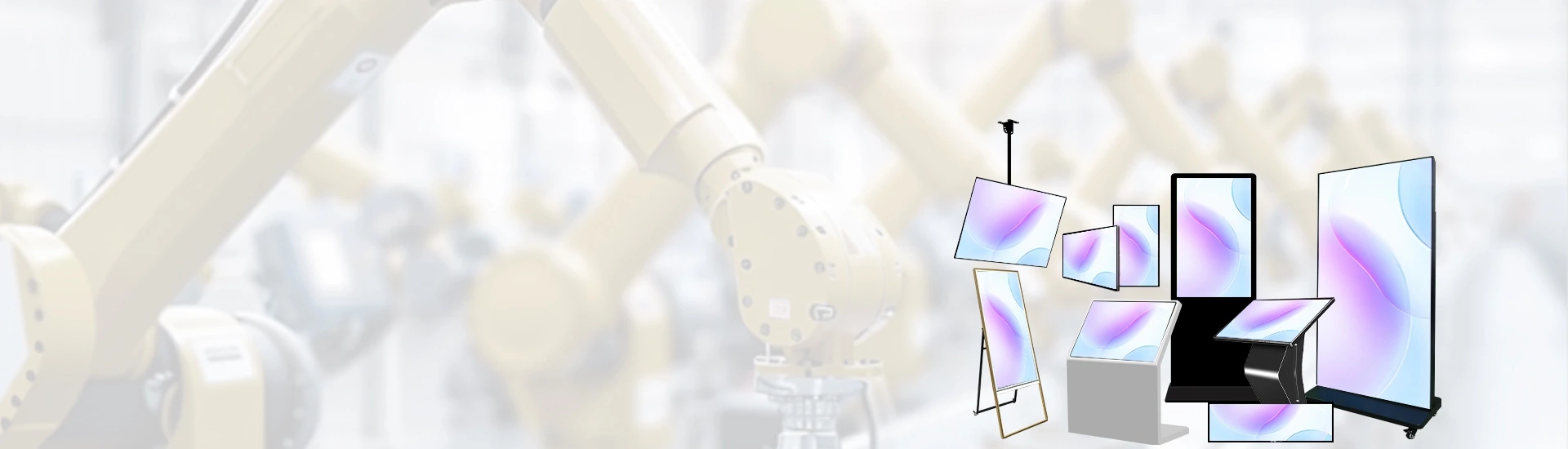
A Practical B2B Buyer's Guide to Totem Digital Signage and Vertical Digital Displays
Vertical digital signage has become a core infrastructure investment for retail chains, shopping mall operators, transit authorities, and brand marketing teams deploying multi-site networks. But the gap between a specification sheet and a successful deployment is wider than most procurement teams expect. Panels that perform well in a showroom can wash out under direct sunlight, fail prematurely in coastal humidity, or create glare problems that undermine the entire visual strategy.
This guide is written for B2B buyers evaluating vertical digital signage displays for commercial rollouts. It covers the five decision dimensions that determine whether a deployment succeeds or fails: screen size and resolution, brightness, anti-glare treatment, IP and environmental protection, and structural form factor. Each section includes real deployment cases from different countries to show how these parameters translate into practice.
| Escenario | Brillo | AG Treatment | Clasificación IP | Typical Format |
|---|---|---|---|---|
| Indoor (controlled light) | 300-500 nits | Optional, low haze | IP20–IP30 | Stand or slim totem |
| Window-facing (direct sun) | 1,500–2,500 nits | 1–5% haze, medium | IP54 | Slim totem or stand |
| Semi-outdoor (sheltered) | 2,500–3,000 nits | 3–5% haze | IP55 | Sealed totem |
| Full outdoor (exposed) | 3,000–5,000+ nits | 3–5% haze + optical bonding | IP65–IP66, IK08+ | Reinforced totem with thermal management |
The single most common procurement mistake in vertical digital signage is selecting parameters before defining the deployment environment. A 3,000-nit outdoor panel deployed in a climate-controlled lobby wastes energy and money. A 500-nit indoor panel placed in a sunlit storefront window becomes invisible during peak shopping hours. The environment determines which parameters are non-negotiable and which are optional.
| Medio ambiente | Core Challenge | Parameter Priority |
|---|---|---|
| Indoor controlled | Viewing distance, content legibility | Resolution > Size > Brightness |
| Window-facing | Sunlight glare, reflection stacking | Brightness > AG > IP |
| Semi-outdoor | Temperature fluctuation, moisture | IP > Brightness > AG |
| Full outdoor | Weather, vandalism, thermal extremes | IP/IK > Thermal > Brightness > AG |
For a broader breakdown of how deployment scenarios shape format selection, see the deployment scenario guide for vertical advertising machines.
Vertical displays are typically specified at 32, 43, 49, 55, 65, 75, 85, and 98 inches in portrait orientation. The selection should be driven by two factors: the distance from which the target audience will view the screen, and the resolution required to maintain legibility at that distance.
| Tamaño de la pantalla | Recommended Viewing Distance | 1080P Sufficient? | 4K Recommended? |
|---|---|---|---|
| 32–43 inch | 1.5–3 meters | Yes | Rarely needed |
| 49–55 inch | 3–5 meters | Yes | For detailed content |
| 65–75 inch | 5–8 meters | Marginal | Recomendado |
| 85–98 inch | 8–15 meters | No | Essential |
For vertical content, the 9:16 aspect ratio requires specific attention to safe margins and text sizing. A common error is designing content for horizontal screens and simply rotating it; this leads to wasted space and reduced readability.
Tysons Corner Center, the largest retail mall in the Washington, D.C. metropolitan area, upgraded its PenFed Plaza with a 3.9mm exterior LED screen measuring approximately 4.6 meters by 9.9 meters. The 1,216 x 2,560 pixel display processes over 3.1 million pixels and serves as a platform for community programming, live events, and brand advertising in an open-air civic space. The project demonstrates how large-format outdoor displays require careful pixel pitch selection to maintain image quality at varying viewing distances across a plaza environment.[reference:0]
Brightness is measured in nits (cd/m²). The critical distinction that spec sheets often obscure is between peak brightness (a laboratory measurement) and sustained brightness (what the display delivers after reaching thermal equilibrium). A panel rated at 3,000 nits peak may deliver only 2,000 nits sustained after 30 minutes of operation. For outdoor deployments, always request the sustained brightness figure and the conditions under which it was measured.
| Brightness Range | Medio ambiente | Key Consideration |
|---|---|---|
| 300-500 nits | Indoor, controlled lighting | Standard commercial grade |
| 700–1,000 nits | Bright indoor, sheltered window | Balance of visibility and power |
| 1,500–2,500 nits | Window-facing, semi-outdoor | Requires thermal management |
| 2,500–5,000+ nits | Full outdoor, direct sunlight | Active cooling essential |
Higher brightness increases power consumption, heat generation, and panel degradation rate. A display operating at 3,000 nits consumes roughly three times the power of a 1,000-nit display of the same size. This directly affects total cost of ownership and should be factored into procurement decisions.
An auto-brightness sensor adjusts luminance based on ambient light conditions, reducing power consumption during nighttime or overcast periods and extending panel lifespan. For outdoor deployments operating 24/7, this feature is strongly recommended.
A leading UK pub retailer deployed 98-inch outdoor displays in beer gardens and outdoor areas across its estate. The screens were specified with 3,000 cd/m² brightness for direct sunlight visibility, an anti-glare display with hard coating (3H), and IP67-rated waterproofing with IK10 vandal resistance. The stainless-steel mounting structure was designed for permanent outdoor installation. After a successful pilot, the solution was rolled out nationwide. The case demonstrates that for hospitality environments, brightness alone is insufficient — anti-glare treatment and vandal resistance are equally critical.[reference:1]
Anti-glare treatment reduces the mirror-like reflection that makes digital displays unreadable in bright environments. The treatment works by creating a micro-textured surface that scatters incoming light rather than reflecting it directly back to the viewer. The effectiveness of AG treatment is measured by haze, expressed as a percentage.
In commercial digital signage specifications, anti-glare haze is commonly set between 1% and 5%. The industry standard test methods are JIS-K7105-1981 and ASTM-D523. Understanding what this range means in practice is essential for procurement decisions.
| Haze Range | Effect | Mejor para |
|---|---|---|
| Below 1% | Insufficient anti-glare, visible reflections | Not recommended for bright environments |
| 1–3% | Balanced: good anti-glare with high clarity | Window-facing, premium indoor |
| 3–5% | Strong anti-glare, slight reduction in contrast | Full outdoor, direct sunlight |
| Above 5% | Noticeable image degradation, hazy appearance | Not recommended for commercial signage |
Haze is not the only parameter that affects visual performance. Gloss (surface reflectivity) and clarity (distinctness of image) also matter. A display with 3% haze and low gloss will outperform one with 3% haze and high gloss in a sunlit environment. When specifying AG treatment, request all three values from the supplier.
| Treatment | Mechanism | Best Application | Trade-off |
|---|---|---|---|
| AG (anti-glare) | Surface scattering | Outdoor, window-facing | Slight clarity loss |
| AR (anti-reflective) | Coating interference | Premium indoor | Higher cost, less durable outdoors |
| Optical bonding | Adhesive layer eliminates air gap | High-ambient-light environments | Higher cost, repair complexity |
| Standard glossy | Ninguno | Controlled indoor lighting | Severe reflection in bright environments |
For window-facing deployments, the most effective approach often combines optical bonding with AG treatment. This eliminates the internal reflection between the LCD panel and the cover glass, which is a common source of glare that surface treatment alone cannot address.
A municipality in an alpine ski town in Switzerland deployed 65-inch double-sided outdoor LCD kiosks for tourism information, cultural promotions, and public safety notifications. Each side used a 2,500-nit high-brightness anti-glare panel to eliminate reflection under high-altitude sunlight. The units featured IP65 protection, a dual heating and cooling thermal system for sub-zero operation, and a built-in light sensor for automatic brightness adjustment. The project demonstrates that in high-altitude or snow-reflective environments, anti-glare treatment combined with thermal management is essential for year-round operation.[reference:2]
IP (Ingress Protection) rating is a two-digit code defined by IEC 60529. The first digit indicates protection against solid objects (0–6), and the second digit indicates protection against liquids (0–8). For digital signage, the relevant ratings are typically IP54 through IP66.
| Rating | Solid Protection | Liquid Protection | Typical Use |
|---|---|---|---|
| IP54 | Dust protected | Splashing water | Sheltered outdoor, window |
| IP55 | Dust protected | Water jets | Semi-outdoor, covered areas |
| IP65 | Dust tight | Water jets (low pressure) | Full outdoor, general |
| IP66 | Dust tight | Powerful water jets | Coastal, heavy rain |
Fenway Park, home of the Boston Red Sox and the oldest ballpark in Major League Baseball, installed 11 outdoor LED signage installations covering 842 square meters. The main centerfield videoboard measures 30.5 by 11.5 meters. The displays exceed 7,000 nits brightness and are IP65-rated to withstand rain, dust, and temperature swings across a six-month baseball season. The project demonstrates that large-scale outdoor venues require brightness and IP protection levels far above standard commercial specifications.[reference:3]
JCDecaux launched the ASPIRE network across six locations in Brisbane, Australia, featuring 8.5-meter-tall digital portrait screens with stainless-steel cladding and energy-efficient technology. Eye-tracking research confirmed that elevated placements above five meters significantly improved visibility and noticeability among people travelling through busy city areas. The project, timed ahead of the 2032 Olympic Games, covers 93% of the Brisbane metropolitan area and delivers over 1.8 million weekly impressions. For vertical digital displays, the case highlights how structural height and placement interact with screen specifications to determine real-world visibility.[reference:4]
Touch capability adds cost, introduces additional failure points, and is not always necessary. The decision should be driven by the content strategy and audience behavior, not by feature availability.
| Consideration | Non-Touch | Toque infrarrojo | Tacto capacitivo |
|---|---|---|---|
| Coste | Lowest | Moderado | Highest |
| Outdoor durability | Excellent | Good (sealed frame) | Moderado |
| Glove operation | N/A | Yes | Limitado |
| Response speed | N/A | Fast | Fastest |
| Mejor para | Advertising, wayfinding | Outdoor kiosks, transit | Indoor self-service |
For outdoor deployments, infrared touch is generally preferred because it maintains functionality with gloves and in wet conditions. Capacitive touch performs poorly when the screen surface is wet. When specifying touch for an outdoor display, verify that the touch layer is compatible with the AG treatment — some AG coatings interfere with capacitive sensing.
The structural form factor determines installation method, stability, aesthetic integration, and maintenance access. The two primary formats for vertical displays are the digital signage stand (floor-standing, typically thinner profile) and the totem digital signage (freestanding, monolithic enclosure).
| Factor | Digital Signage Stand | Totem Digital Signage |
|---|---|---|
| Instalación | Indoor, level floors | Indoor, semi-outdoor, outdoor |
| Movilidad | Movable, some with casters | Fixed, bolted or weighted base |
| Estabilidad | Moderado | High (wind-load engineered) |
| Material | Aluminum or thin steel | Thick steel or stainless steel |
| Weather protection | Mínimo | IP-rated sealed enclosure |
| Coste | Inferior | Superior |
| Expected lifespan | 3–5 years | 7–10+ years |
For a detailed breakdown of vertical display formats and their deployment boundaries, see the guide to vertical digital signage types and components.
Ocean Outdoor Germany deployed The Loop network at Westfield Centro in Oberhausen, comprising 38 screens on 19 strategically placed digital totems across both indoor and outdoor areas of the shopping center. The totems are positioned at high-traffic touchpoints throughout the complex, including entrances, food courts, and leisure areas. The deployment demonstrates how totem structures enable consistent brand presence across mixed indoor-outdoor environments within a single venue.[reference:5]
The internal technology stack determines how content is managed and how the display integrates with existing infrastructure. Key decisions include:
Certification requirements vary by target market. For B2B deployments, the following are commonly required:
| Market | Required Certifications | Notes |
|---|---|---|
| European Union | CE (EMC, LVD, RoHS) | Mandatory for all electronic products |
| North America | FCC, UL/ETL | FCC for electromagnetic compliance; UL/ETL for electrical safety |
| Middle East | CE or SASO (varies) | Country-specific requirements |
| Australia/NZ | RCM | Covers EMC and electrical safety |
Always verify that the certification covers the specific model being procured — some certifications are issued for a product family rather than individual configurations.
The purchase price of a vertical advertising machine typically represents only 40–55% of the total cost over a five-year deployment period. The remaining costs include:
Where to invest: AG treatment, thermal management, and structural quality directly affect lifespan and reliability. Where to save: overspecified resolution for large-format displays viewed from distance, unnecessary touch functionality, and brightness levels above what the environment requires.
| Categoría | Questions |
|---|---|
| Brillo | What is the sustained brightness after thermal equilibrium? Under what ambient conditions was this measured? |
| AG Treatment | What is the haze value and test standard (JIS/ASTM)? What is the gloss value? Is optical bonding used? |
| Protección | Can you provide IP and IK test reports? What is the operating temperature range and test conditions? |
| Thermal | What cooling method is used? Is heating included for cold-climate deployment? |
| Estructura | What is the steel thickness? What wind load is the structure engineered for? What anchoring method is recommended? |
| Software | What CMS is supported? Is offline playback available? How are content updates pushed? |
| Commercial | What is the MOQ? Is OEM/ODM available? What is the warranty period and spare parts policy? |
For shaded or north-facing outdoor positions, 2,500 nits is a working minimum. For south-facing or fully exposed locations, 4,000 nits or higher is recommended. Always verify sustained brightness rather than peak rating.
It refers to the percentage of light scattered by the anti-glare surface treatment, measured per JIS-K7105-1981 or ASTM-D523. A haze value of 1–3% balances anti-glare performance with image clarity; 3–5% provides stronger anti-glare for direct-sunlight environments at a slight cost to contrast.
IP65 protects against dust and low-pressure water jets, which is sufficient for most outdoor installations. Coastal environments or areas with heavy driving rain may require IP66. IP rating alone is not sufficient — thermal management, IK rating, and corrosion protection are equally important.
A digital signage stand is a thinner-profile floor-standing unit designed primarily for indoor use. A totem digital signage is a monolithic, sealed enclosure engineered for outdoor deployment with weather protection, structural reinforcement, and thermal management.
If the content strategy does not require user input, non-touch reduces cost and failure points. For interactive applications in outdoor or glove-use environments, infrared touch is generally more reliable than capacitive.
For screens up to 55 inches viewed from 5 meters or less, 1080P is sufficient. For 65 inches and above, or for content with fine detail, 4K is recommended to maintain perceived sharpness.
The selection of a vertical advertising machine is a multi-variable decision. Environment determines parameter priority. Brightness must be matched to ambient light conditions. Anti-glare treatment must be specified with the correct haze value for the application. IP and IK ratings must be verified with test data, not just the rating number. Structure must be engineered for the installation site. And the entire configuration should be evaluated against total cost of ownership, not purchase price alone.
The case studies above — from a Virginia shopping plaza to a Brisbane street network, a UK pub chain, a German mall, a Swiss alpine town, and an American ballpark — illustrate that no single specification works across all deployments. The right configuration is the one that matches the specific environment, content strategy, and operational requirements of each site.
Share your deployment environment and content requirements. Our team will recommend the optimal configuration and provide a sample unit for evaluation.

 SPA
 EN
 AR
 DAN
 IT
 ARM
 FIN
 SWE
 NOR
 MAY
 NL
 TH
 KOR
 PL
 RU
 PT
 FRA
 DE
 CHT
