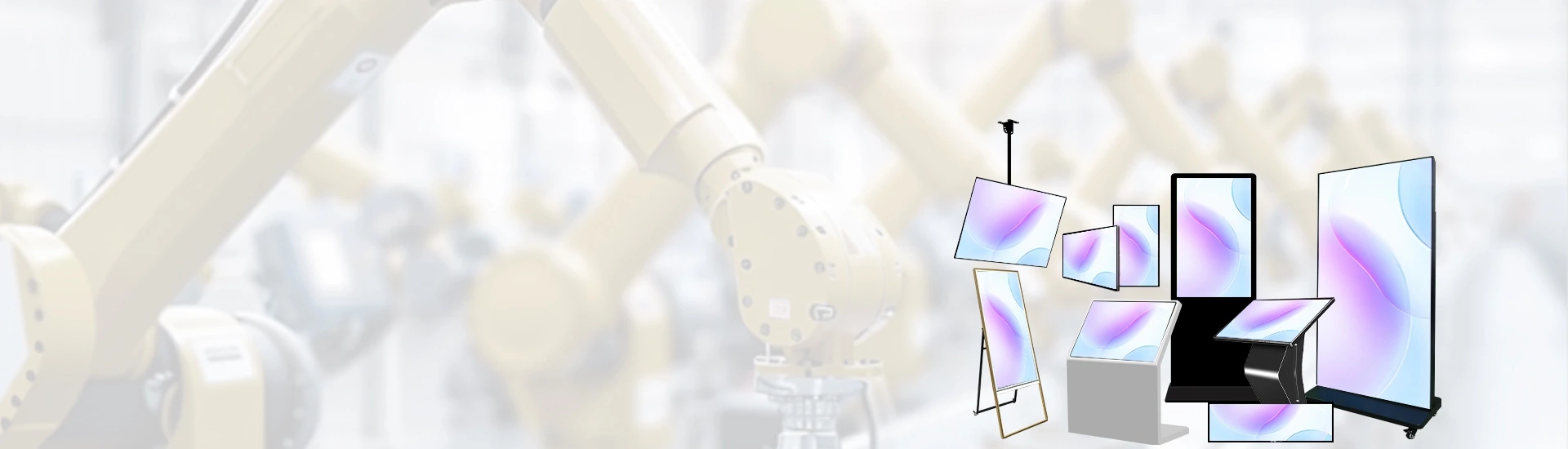
This page turns a product catalog into a procurement decision. It is written for technical selection and procurement engineers who must converge on a configuration before an RFQ is issued.
Model-level parameters for the 21.5, 23.8, 27 and 32 inch units, including Android 9 to 16, optional touch and mobile floor stand configurations, remain on the Portable Smart TV product page.
Each dimension below is paired with the commercial scenario in which it decides success or failure. Read the decision line first, then the specification range.
Panel price should not drive the size decision. Viewing distance and interaction mode should. The 21.5 24 27 32 inch Portable Smart TV range covers FHD and 4K panels across guest rooms, clinics, retail floors, training rooms and exhibition booths.
Resizing after tooling and certification triggers a full re-validation cycle. Lock the size at sample stage, not at mass production.
Any scenario where the end user must complete a task fails acceptance without touch. The touch and non-touch Portable Smart TV choice should follow the workflow, not the price list.
Abattery powered Portable Smart TV configuration removes the need for a fixed outlet. It also adds transport documentation and cycle-life planning to the project.
Stand failures are rarely reported as stand failures. They appear as damaged panels, injury claims or rejected site inspections. In hotels, clinics and exhibition halls, most damage claims trace back to the stand rather than the panel.
ThePortable Smart TV Models in this series span RK3566, RK3576 and RK3588 platforms, with Android 9 to 16, 4 or 8 GB RAM and 32 or 64 GB storage. Each platform carries its own supply window and its own Android support horizon.
Wi-Fi 5 and Wi-Fi 6, Bluetooth 5.0, HDMI, USB, Type-C and audio output are available. A wireless Portable Smart TV configuration is only useful when the casting protocol and the management path are both confirmed against the site.
Start from the deployment scenario, not the datasheet. The third column names the dimension that cannot be compromised. The fourth column describes what typically goes wrong when it is.
| Project scenario | Spec combination to lock | Non-negotiable dimension | Typical failure if compromised |
|---|---|---|---|
| Hotel guest rooms and suites | 27 or 32 inch, non-touch priority, mobile stand with lockable casters, wireless casting | Size, Stand | Close-range panel in a far-view room fails guest satisfaction; free-rolling stand drifts during housekeeping |
| Self-service ordering and in-store interaction | 21.5 inch, touch, anti-glare surface, interface confirmed against POS hardware | Size, Touch, Interface | Non-touch unit cannot complete the order flow; port mismatch blocks proof-of-concept |
| Fitness and beauty studios | 27 inch, touch optional, continuous-run thermal check, stand rigid after braking | Stand, System | Stand shifts mid-session; system throttles during back-to-back classes |
| Retail pop-ups and exhibitions | 21.5 to 32 inch, battery support where floor power is absent, touch for lead capture, transport file ready | Power, Size | Battery configuration cannot ship without complete documents; oversized unit does not fit the booth footprint |
| Healthcare and aged care | 23.8 or 27 inch, battery priority, low centre of gravity, lockable casters, controlled system permissions | Power, Stand, System | Battery shipment held at destination; unbraked stand becomes a collision risk at bedside |
| Meeting rooms and showrooms | 27 or 32 inch, wireless casting, HDMI, USB and Type-C for room peripherals | Interface, System | Casting protocol incompatible with existing laptops; insufficient ports for camera and audio |
| Education and training | 27 or 32 inch, touch, height adjustable stand, app deployment matched to campus network | Touch, Stand, System | Touch failure interrupts lessons; fixed height unsuitable across age groups |
The Android version tells you what ships this quarter. The SoC tells you what you can reorder in year three.
Three supply layers must align: the product layer (your rollout and spare-pool plan), the module layer (the SoM vendor's revision and pin-compatibility path) and the silicon layer (the chip vendor's lifecycle commitment). The safe structure is product life shorter than SoM supply period, and SoM supply period shorter than chip lifecycle. If the SoM changes without pin compatibility, the carrier board, enclosure and mounting points may need re-engineering mid-rollout.
Write lifecycle terms into the RFQ rather than accepting a datasheet statement. The following wording is used on multi-phase projects:
Where the architecture allows, separating the compute module from the display hardware decouples the two lifecycles without changing the installation footprint.
These two items rarely appear on a datasheet. Both sit outside the product specification and inside the delivery schedule.
Any battery powered Portable Smart TV configuration introduces a documentation obligation. Confirm the full package at RFQ stage.
A supplier that can quote a unit but cannot produce the test summary at RFQ stage adds weeks to the inbound schedule.
Institutional carts used with flat-panel equipment are assessed against tip-over stability expectations for tall carts. The procurement action is to ask for the specification, then test a sample on the actual floor surface.
These six items cannot be corrected after tooling or after the first shipment. Each should be answered in writing in the RFQ response.
Customization only matters when it maps to a dimension the project depends on. The boundaries below follow the same six dimensions as the matrix.
Brand logo, custom UI, structural design changes, stand modification, system and application development, and packaging design are all supported. Requests are reviewed against the project timeline before quotation.
The profiles below describe project types rather than named accounts. Each one shows which specification was locked and what changed as a result.
문제 Guest rooms needed movable displays without wall drilling. Housekeeping reported repeated collision damage with the previous freestanding units.
Specs locked 27 inch non-touch configuration, mobile stand with lockable silent casters, Wi-Fi casting for guest devices, mains power only to avoid battery handling in a high-turnover property.
결과 Caster locking behaviour was verified at sample stage, and the sliding issue was removed before the first batch shipped. Mains-only selection also kept the shipping file simple for a property receiving containers monthly.
문제 A four-week brand activation in a mall atrium had no fixed floor power and required interactive lead capture at the booth edge.
Specs locked 21.5 inch touch configuration, battery support sized to a full trading day, anti-glare surface treatment, and transport documents issued together with the commercial invoice.
결과 The documentation package was confirmed before the booking, so the air shipment cleared without a hold. The 21.5 inch size matched the standing interaction distance at the booth counter.
문제 Sessions ran back to back, and displays moved between the studio floor and the reception area several times a day.
Specs locked 32 inch non-touch configuration for group visibility, continuous-run thermal validation on the selected SoC, lockable casters, and a mains configuration with a defined cable length for the studio layout.
결과 Thermal behaviour was confirmed during a sample run rather than after installation, and the stand remained stable during scheduled class changes.
문제 The facility needed bedside and common-area use with strict infection-control cleaning and restricted resident access to system settings.
Specs locked 23.8 inch configuration, battery support for bedside use without trailing cables, low centre of gravity with lockable casters, and kiosk mode with a controlled application set.
결과 The cleaning agent and surface treatment were agreed in writing, and system permissions were fixed before deployment across the first wing.
문제 Training rooms were reconfigured weekly, and presenters used a mix of Windows laptops and mobile devices.
Specs locked 27 inch touch configuration, height-adjustable mobile stand, wireless casting verified against the two laptop platforms in use, and HDMI plus Type-C for legacy room equipment.
결과 Casting compatibility was tested on site-representative hardware before the order, removing the most common cause of first-week support tickets.
Ask for a written minimum supply term per SoC, an end-of-life notice period, and the compatibility rules for a replacement platform. A current Android version alone does not answer the question, because the constraint is usually the SoC supply window rather than the software release.
For any battery-supported configuration, request the UN38.3 test summary, the IEC 62133 report, the MSDS, and confirmation of packaging marks and destination restrictions. These should be issued with the quotation, not requested after the order is placed.
Confirm caster type, braking behaviour and whether the unit approaches a rigid condition after locking, together with rated load, height and tilt range, and floor compatibility. In care environments, low centre of gravity and controlled system permissions should be part of the same confirmation.
Send your deployment scenario, destination country and expected volume. We will return the specification sheet, the six confirmation points above, and a sample plan matched to your timeline.

 KOR
 EN
 AR
 DAN
 IT
 ARM
 FIN
 SWE
 NOR
 MAY
 NL
 TH
 PL
 RU
 PT
 SPA
 FRA
 DE
 CHT
