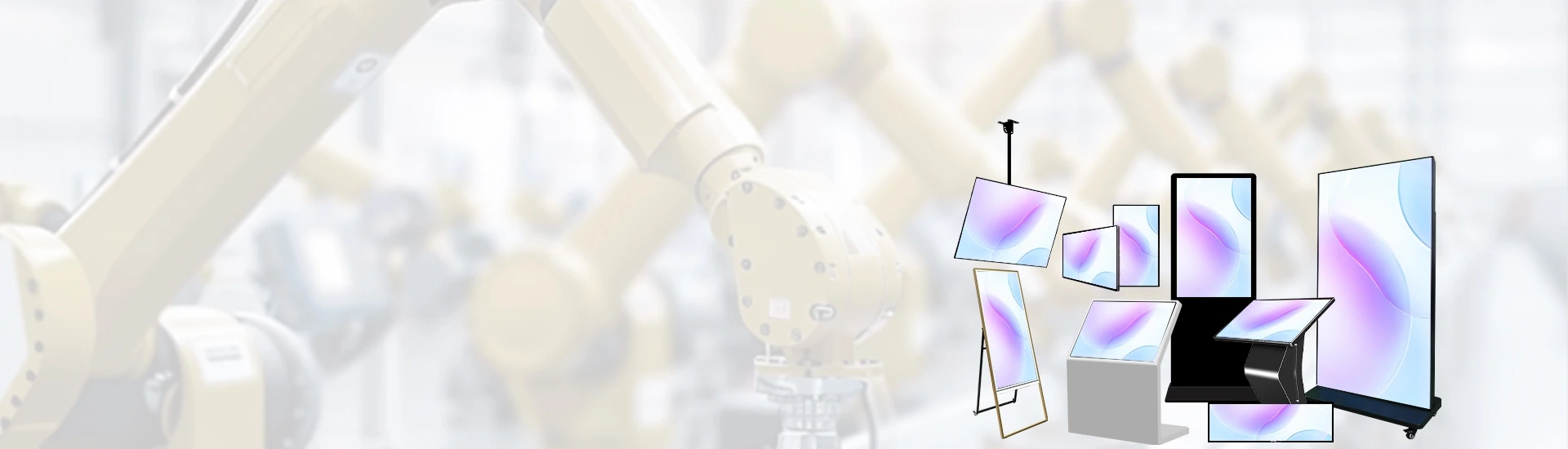
Retail stores, hotel lobbies, airports, and corporate spaces increasingly rely on vertical digital signage to capture attention and deliver dynamic content. Yet many B2B buyers struggle to distinguish between floor-standing units, wall-mounted screens, touch kiosks, and video walls.
This guide breaks down the types, core components, and real-world differences of vertical digital signage so you can specify the right display for your project—without overspending or underperforming.
Vertical digital signage refers to portrait-oriented display systems designed for standing-viewer engagement. Common in retail, hospitality, transportation, and corporate environments, these displays present content in a 9:16 or similar vertical aspect ratio, aligning naturally with human height and eye-level scanning.
These terms are frequently used interchangeably, but they describe different dimensions of the same product category:
| Term | Dimension | What It Emphasizes |
|---|---|---|
| Vertical / Portrait | Orientation | Screen direction (9:16 vs. 16:9) |
| 床-立っている | インストール | Stands directly on the floor |
| Free-standing | インストール | Independent unit, not wall-dependent |
| Column / Pillar | Form factor | Narrow, column-like footprint |
| Totem | Form factor | Tall, monolithic standalone unit |
By orientation: portrait vs. landscape.
By installation: floor-standing, free-standing, pillar/column, or totem.
By environment: indoor vs. outdoor. Outdoor units require 2500+ nits brightness and IP65+ protection.
By interaction: display-only or touch-enabled vertical digital display.
It is not a wall-mounted screen, not a horizontal touch kiosk, and not a video wall. Each category solves a different problem—and choosing the wrong one leads to wasted budget and poor performance.
Indoor panels typically deliver 350–700 nits brightness, while outdoor models require 2500+ nits. Key specifications include 4K resolution, 178° viewing angle, 3000:1 contrast ratio, and 7×24 hour operation capability.[reference:0]
Commercial-grade steel structures ensure stability and anti-tip safety. Outdoor enclosures require IP65 or higher protection, with reinforced concrete base installation for high-wind environments.[reference:1]
Android or Windows-based players support remote CMS management, scheduled playback, split-screen content, and multiple connectivity options (Wi-Fi, 4G, LAN).[reference:2]
Capacitive and infrared touch options are available for interactive wayfinding, product browsing, and self-service applications.
Each comparison uses the same dimensions: installation, space usage, flexibility, content format, interactivity, cost, and maintenance.
Vertical digital signage stands independently and can be repositioned as floor plans change. Wall-mounted displays save floor space but depend on wall structure and are fixed in place.
Bottom line: Choose vertical digital signage when you need flexibility and floor-level engagement. Choose wall-mounted when space is tight and content is permanent.
Vertical digital signage is optimized for standing viewers—ideal for advertising and brand exposure. Horizontal kiosks suit seated users for service queries and information retrieval.
Bottom line: Vertical for display-first engagement. Horizontal for service-first interaction.
Vertical digital signage delivers single-point independent display. Video walls create large-scale panoramic visuals for immersive group viewing. Video walls demand higher installation complexity and content production costs.
Bottom line: Vertical for targeted messaging. Video walls for scale and spectacle.
| Dimension | 垂直デジタルサイネージ | 壁に取り付けられた | タッチキオスク | Video Wall |
|---|---|---|---|---|
| インストール | Floor-standing / free-standing | Wall bracket | Floor or table | Wall or frame |
| Space usage | Medium (floor footprint) | Low (zero floor) | Medium to high | High (large area) |
| 柔軟性 | High (movable) | Low (fixed) | Medium | 低い |
| Content format | Portrait 9:16 | Landscape 16:9 | Portrait or landscape | Large-scale multi-panel |
| 相互作用 | Optional touch | Rarely touch | Touch-first | Rarely touch |
| コスト | Medium | Low to medium | Medium to high | 高い |
| メンテナンス | Easy (front access) | 中程度 | 中程度 | Complex |
| Best for… | Retail, lobbies, wayfinding | Space-limited walls | Service desks, check-in | Control rooms, stadiums |
評価するとき digital signage vertical display options against alternatives, consider your content strategy, available floor space, and whether interactivity is a requirement.
Retail / hotel / airport / corporate / outdoor.
Outdoor requires 2500+ nits and IP65+ protection.
Touch adds cost but enables wayfinding and self-service.
結果: Match your answers to the comparison table above.
These deployments demonstrate how vertical digital signage performs in demanding B2B environments across different countries.
New York City's LaGuardia Terminal B deployed 39 specialized commercial displays, including vertically-oriented information totems at baggage claim, security checkpoints, and flight information areas. Seven ReadySeeGo digital signage totems use vertically-oriented 86-inch Ultra Stretch displays to present security line information such as banned items and wait times.[reference:3][reference:4]
The top display of each FID unit presents flight information, while the bottom display shows terminal retail maps alongside public service announcements and commercial advertisements.[reference:5]
A Swiss alpine ski town deployed customized 65-inch double-sided outdoor LCD kiosks with 2500nits high-brightness panels and IP65 full weather protection. These vertical digital displays deliver municipal tourism information, local cultural promotions, and public safety notifications for pedestrians and drivers.[reference:6]
The units feature a low-temperature adaptive constant temperature system that keeps internal components stable even under freezing alpine conditions, preventing screen freezing and startup failure. Two screens run different content simultaneously to cover traffic from opposite directions, remotely managed via cloud CMS without on-site maintenance.[reference:7]
Frankfurt Airport Terminal 3 integrated AV systems across its duty-free and travel-value retail areas, spanning 3,000 square meters serving up to 19 million passengers annually. The non-Schengen retail area is framed by P1.5 GOB LED screens configured as vertical portal displays at the duty-free entrance.[reference:8][reference:9]
The GOB surface was selected for its durability in a 24/7 terminal environment. Two additional screens anchor the beauty and LTC product zones, maintaining unified resolution and processing across both sides of the terminal. A double-sided digital signage monitor in the tobacco zone provides visibility from both aisle directions.[reference:10]
The Milwaukee Bucks became the first sports team in the United States to implement digital billboards on arena stair risers. Using technology from StairMedia, vertical billboards were installed on two Fiserv Forum staircases frequently shown during broadcasts.[reference:11]
The LED screens sync together, allowing a single large image—such as a soda bottle—to be split across multiple displays. Advertisers see an estimated 25% lift in exposure when combining StairMedia signage with traditional in-arena screens. The displays are visible to television viewers as well as those seated on the non-bench side of the court.[reference:12]
Consider hardware, installation, software licensing, maintenance, and energy consumption. Short-term campaigns favor rental or low-cost units; long-term installations justify investment in durable, serviceable hardware with strong after-sales support.
It is used for retail promotions, hotel information, airport wayfinding, corporate branding, and outdoor advertising—any scenario where standing-viewer engagement is the priority.
Vertical digital signage is free-standing and movable, while wall-mounted displays are fixed to a wall and depend on wall structure.
Yes, but outdoor models require 2500+ nits brightness and IP65+ protection to withstand weather and glare.
Only if you need interactive wayfinding, product browsing, or self-service. Display-only units cost less and are easier to maintain.
Indoor 55-inch units typically start from a few hundred USD, while outdoor 65-inch double-sided models with IP65 and 2500 nits can range into several thousand USD depending on specifications.
Get a tailored recommendation for your project—whether it's indoor retail, airport wayfinding, or outdoor municipal deployment.
WhatsApp: +86 18124715048

 JP
JP
 EN
EN  AR
AR  DAN
DAN  IT
IT  ARM
ARM  FIN
FIN  SWE
SWE  NOR
NOR  MAY
MAY  NL
NL  TH
TH  KOR
KOR  PL
PL  RU
RU  PT
PT  SPA
SPA  FRA
FRA  DE
DE  CHT
CHT 