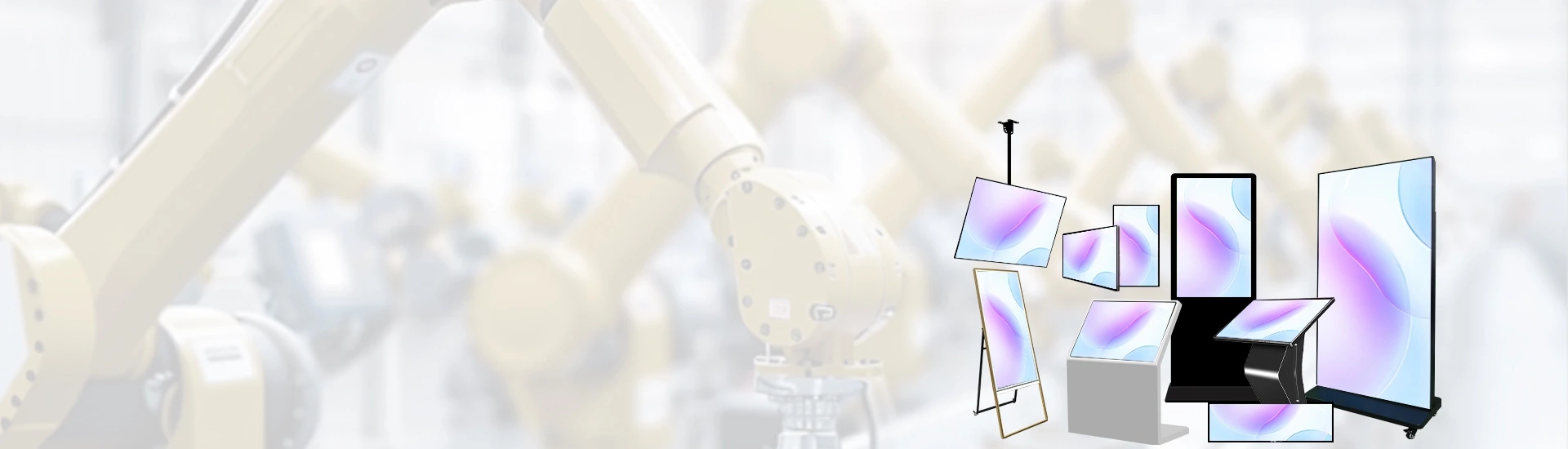
Static posters expire the moment they are printed. Brand guidelines drift across locations, promotional cycles move faster than print lead times, and foot traffic is increasingly fragmented across channels. A vertical digital signage display solves these problems through scheduled playback, remote content updates, and continuous operation — but only when the LCD hardware matches the deployment environment.
This guide is written for procurement managers, facility operators, system integrators, and brand teams evaluating LCD vertical advertising machines for multi-site rollouts. The core argument is straightforward: the scenario determines the form factor. A rotating signage platform performs differently in a retail window than in a mall atrium or an outdoor plaza. Choosing the wrong brightness, IP rating, or physical format leads to washed-out visuals, premature panel failure, or wasted floor space. The following sections break down four core deployment scenarios, specify the technical requirements for each, and provide a selection framework for B2B buyers.
B2B buyers encounter three primary formats in the commercial LCD vertical advertising category. Each addresses a different combination of visual impact, installation environment, and budget tier. The types and components of vertical digital signage are frequently grouped together, but their deployment boundaries are distinct.
| Format | Visual Effect | Installation Environment | Typical Scenarios | Budget Tier |
|---|---|---|---|---|
| Standard vertical LCD digital signage display | Static portrait LCD panel, single-direction viewing | Indoor, controlled lighting | Retail aisles, menus, information boards | Entry to mid-range |
| Window Digitalis display totem | Tall, monolithic LCD totem, double-sided or single-sided | Indoor, semi-outdoor, outdoor | Mall entrances, lobbies, plazas, transit hubs | Mid to premium |
| Rotating signage platform | Dynamic, 360° viewing, horizontal/vertical switching | Indoor, sheltered semi-outdoor | Retail windows, exhibitions, atriums, showrooms | Premium to custom |
Päätös rotating signage platform is treated here as a distinct format because its auto-rotation capability — switching between horizontal and vertical orientations — changes how content is authored, scheduled, and perceived by passing audiences. It is not simply an LCD screen with a motor. For a complete breakdown of form factor selection, see the B2B buying guide for vertical advertising machines.
Each scenario below follows the same structure: business needs, environmental challenges, recommended format, key specifications, and procurement considerations. The specifications cited are based on commercial-grade LCD deployment standards and should be validated against site surveys and regional electrical codes.
Retail chains — fashion, beauty, electronics, jewelry, convenience — deploy vertical LCD displays to synchronize promotions across locations and capture attention in competitive storefront environments. The primary need is real-time content updates without local staffing. A single marketing team can push a new campaign to hundreds of stores simultaneously through a CMS.
Deployment note (United States): A convenience store chain deploying 55-inch vertical LCD displays across 200 locations in Texas and Florida required 700-nit panels for in-store use and 2,000-nit window units in south-facing storefronts. The rotation platform was reserved for flagship locations only, where the auto-switching capability between vertical fashion lookbooks and horizontal cinematic promotions justified the higher unit cost.
Shopping centers and corporate lobbies operate under continuous foot traffic with diverse viewing distances. The LCD display must serve two functions simultaneously: visitor navigation and commercial messaging. In multi-level malls, the atrium void offers vertical space that wall-mounted screens cannot exploit.
Deployment note (Netherlands): At a Westfield shopping center in Amstelveen, 18 LCD totems were installed across indoor and outdoor zones. Five double-sided outdoor totems were anchored with additional foundations for weather resistance, while 13 indoor totems were positioned for wayfinding and advertising. The solution included integrated power meters and an SLA-backed data backup for operational continuity.
Outdoor deployment is where specification errors become most costly. Direct sunlight, rain, dust, temperature swings, and 24/7 operation expose weaknesses in LCD panels, enclosures, and cooling systems that indoor units never face. Semi-outdoor — a covered plaza, a transit shelter, or a window facing outward — is the most common mis-specified category.
Deployment note (United Kingdom / Portugal): Semi-outdoor LCD displays facing a shop window from the inside require a different specification than a totem standing on the pavement. A 3,000-nit window-facing LCD display uses an asymmetric panel: the outward-facing side runs at high brightness for sunlight readability, while the inward-facing side runs at 400–700 nits for comfortable indoor viewing. This dual-brightness approach is increasingly specified for retail window LCD applications.
Trade shows, pop-up stores, product launches, and corporate events share a common constraint: the LCD display must be transportable, fast to set up, and visually arresting. Event schedules rarely allow for complex installation or heavy rigging. The display is also competing for attention in a high-noise visual environment.
Deployment note (Germany): At a consumer electronics trade fair in Berlin, a 55-inch rotating LCD signage platform was deployed as the centerpiece of a 6m × 3m booth. The unit cycled through three content modes per hour: vertical product specification sheets, horizontal brand storytelling video, and a 90-degree rotated interactive demo loop. Floor space occupied was under 1.5 square meters, but the rotating motion consistently drew passersby from adjacent aisles.
The following checklist covers the LCD specifications most frequently mis-specified or omitted during the procurement process. Each item has direct cost and performance implications across the deployment lifecycle.
Requirement: A regional shopping center required wayfinding and advertising LCD displays across indoor and outdoor zones. Indoor units needed to be removable for planned renovations.
Liuos: 18 digitalis display totems deployed across the property. Five double-sided outdoor LCD totems were installed with additional foundation anchoring. Eleven double-sided indoor totems and two single-sided indoor totems were positioned for maximum visibility. All units were pre-assembled and plug-and-play tested before installation.
Specifications: Samsung commercial-grade LCD panels, stainless steel finishing with integrated ambient lighting strips, integrated power consumption meters, SLA-backed data backup.
Outcome: A unified LCD digital signage network covering both indoor and outdoor visitor touchpoints, with energy monitoring and a design that accommodates future renovation cycles without permanent obstruction.
Requirement: A flagship doughnut retail store in Times Square required an exterior LCD display element that would function as both a brand landmark and a promotional channel, operating 24 hours a day in a high-traffic tourist environment.
Liuos: A 15-foot rotating signage platform was installed as the exterior centerpiece, integrated with a wraparound LCD digital billboard and a curved LCD display band. The rotation mechanism was specified for continuous operation with high-brightness commercial LCD panels rated for visibility against Times Square's ambient light.
Specifications: 8,000-pound rotating structure, high-brightness commercial LCD panels, weather-sealed enclosure suitable for year-round operation.
Outcome: The rotating LCD sign became the visual anchor of the storefront, drawing attention from Broadway and 7th Avenue traffic. The rotation ensures the branded message is visible from multiple pedestrian approach vectors without requiring multiple LCD screens.
Requirement: A municipality required a network of outdoor LCD digital displays to communicate events, public information, and emergency updates across multiple locations.
Liuos: 10 digitalis display totems with IP65-rated outdoor LCD structures and remote content management were installed at key public locations.
Specifications: High-brightness LCD panels (2,500 nits), IP65 enclosure, remote CMS for centralized content scheduling and distribution.
Outcome: Centralized control of event information across the municipal LCD network, with consistent visibility regardless of location or weather conditions.
The following framework is designed for procurement teams evaluating multiple sites or planning a phased LCD rollout. Each step narrows the specification space before pricing is requested.
Indoor, semi-outdoor, or full outdoor. This determines the LCD brightness floor, IP rating minimum, and whether the enclosure requires active cooling or heating. A window-facing LCD display in a sheltered location occupies a different specification tier than a totem on an exposed sidewalk.
Brand image, short-term promotion, or continuous operational communication. Brand and promotional LCD displays prioritize visual impact and content flexibility. Operational displays prioritize uptime, remote management, and integration with existing systems.
Stationary viewers (waiting areas, lobbies) versus moving viewers (aisles, entrances, street traffic) versus multi-directional viewers (atriums, open plazas). A rotating signage platform is best suited to multi-directional viewing environments. Stationary-viewer scenarios are served adequately by a standard vertical digital signage display at lower cost.
Include LCD hardware, CMS licensing or subscription, installation labor, electrical work, network connectivity, and projected maintenance. For multi-site deployments, request unit pricing at projected volume tiers and confirm that the quoted configuration matches the certification requirements for each destination market.
A standard vertical digital signage display is typically a single-sided portrait LCD screen with a slim chassis, designed for indoor use in controlled lighting. A digitalis display totem is a taller, structurally reinforced LCD unit that can be configured as single-sided or double-sided, and is available with outdoor-rated enclosures (IP65) for deployment in plazas, building entrances, and transit environments. The totem form factor supports larger LCD screen sizes and higher brightness configurations than most standard vertical displays.
Not necessarily. A standard vertical LCD display is sufficient for in-aisle promotions, shelf-end messaging, and menu boards where the audience approaches from a single direction. A rotating signage platform adds value when the LCD display is positioned in a window, at a store entrance, or in a location where audiences approach from multiple angles, or when the content strategy requires alternating between vertical and horizontal content formats within a single unit. For flagship locations and high-traffic windows, the rotation capability often justifies the additional cost.
Window-facing LCD displays require 1,500–2,500 nits for consistent readability during daylight hours. The specific requirement depends on the window orientation (north-facing windows receive less direct sunlight than south-facing), the presence of awnings or tinting, and the local climate. Dual-brightness configurations — where the outward-facing LCD panel runs at high brightness and the inward-facing panel runs at 400–700 nits — are recommended for applications where both sides of the display are viewed.
IP54 is the minimum for semi-outdoor locations with overhead cover. IP65 is required for full outdoor LCD exposure to rain, dust, and direct sunlight. Outdoor installations in coastal, desert, or high-temperature environments may require additional surge protection, anti-corrosion treatments, and active thermal management beyond the base IP rating.
Yes. Commercial LCD display manufacturers offer OEM/ODM customization covering hardware structure, port configuration, software interface, pre-installed applications, logo and packaging branding, and color finishing. Typical minimum order quantities for custom LCD configurations start at 10 units, with lower thresholds available for sample or pilot orders. Certification requirements (CE, FCC, UL, RoHS) should be confirmed at the quotation stage for each destination market.
A cloud-based CMS is the standard solution for multi-site LCD deployments. The CMS allows central scheduling, content distribution by location or screen group, real-time device monitoring, and remote troubleshooting. Key CMS evaluation criteria include user permission controls, API availability for integration with marketing platforms, and offline playback support for locations with unreliable connectivity.
The deployment environment, not the LCD specification sheet, should drive the procurement decision. A rotating signage platform delivers maximum value in multi-directional viewing environments with high visual competition — exhibitions, retail windows, atriums, and showrooms. A digitalis display totem is the appropriate choice for wayfinding, outdoor advertising, and entrance communication where durability and visibility at distance are the primary requirements. A standard vertical digital signage display remains the most cost-effective LCD solution for indoor, single-direction viewing in controlled environments.
For procurement teams planning multi-site rollouts, the critical verification points are: certification coverage for each destination market, CMS compatibility with existing content workflows, warranty and spare parts availability, and a realistic TCO model that accounts for content operations and maintenance beyond the initial LCD hardware purchase.
Share your deployment scenario — environment, screen size, brightness requirement, and quantity — and our team will provide an LCD configuration recommendation with certification details, MOQ, and lead time.

 FIN
 EN
 AR
 DAN
 IT
 ARM
 SWE
 NOR
 MAY
 NL
 TH
 KOR
 PL
 RU
 PT
 SPA
 FRA
 DE
 CHT
