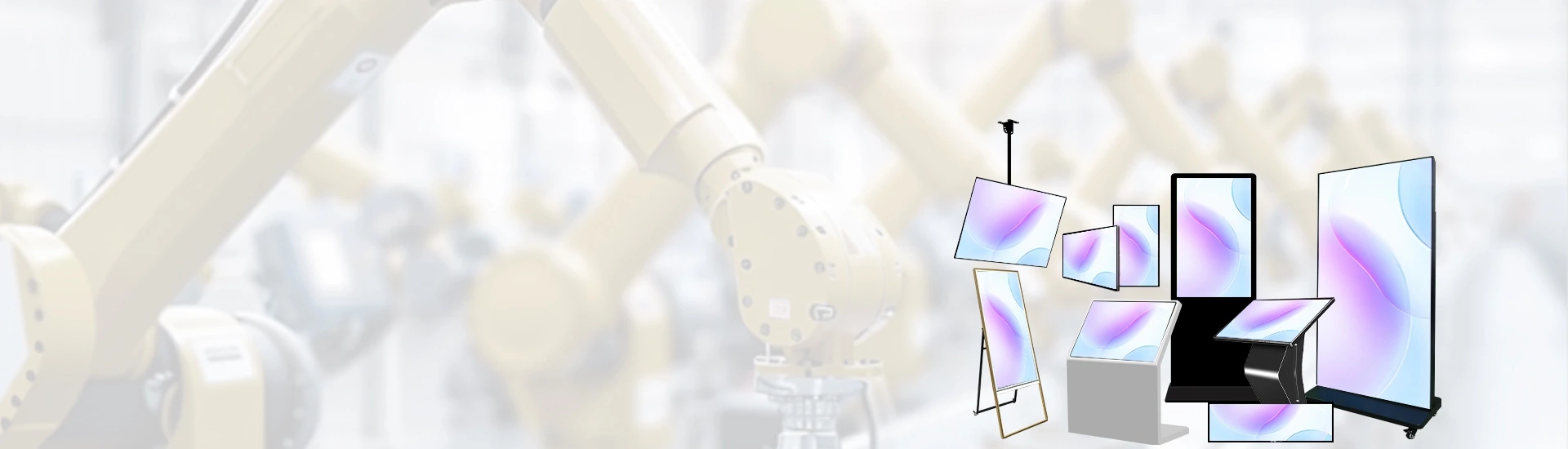
A 55-inch vertical advertising machine can carry an FOB price gap of 3× or more between two suppliers quoting the same nominal size. That gap is rarely about the screen alone. It reflects panel grade, brightness class, ingress protection, media player architecture, enclosure engineering, certification scope, and after-sales commitments. This guide breaks down real price ranges, bulk-order discount ladders, OEM procurement workflows, and procurement budgeting methods for international buyers sourcing Digitale Beschilderung im Innenbereich and outdoor commercial displays.
The following prices are for reference only, excluding destination duties, customs clearance, and last-mile delivery. Final pricing depends on panel availability, order volume, exchange rates, and destination certification requirements.
| Model Type | Typical Sizes | Key Configuration | Indicative FOB Range |
|---|---|---|---|
| Mainstream commercial indoor model | 43"–55" | FHD/4K, Android or Windows, 400–500 nits | $560–$1,200 |
| Large-format portrait display | 65"–86" | 4K, high-grade panel, reinforced enclosure | $1,100–$4,200 |
| High-brightness outdoor model | 43"–75" | 2,500–5,000 nits, IP54/IP65, thermal design | $900–$6,500 |
| Dual-screen / interactive model | 43"–55" | Dual screen, PCAP touch, camera/sensor optional | $1,200–$3,500 |
| Order Quantity | Typical Price Adjustment | Why the Price Changes |
|---|---|---|
| 1–9 units | List / sample price | Small production batch, higher handling and packaging cost |
| 10–49 units | About 5%–12% lower | Consolidated production scheduling and packaging |
| 50–199 units | About 10%–20% lower | Improved panel and component purchasing terms, dedicated line time |
| 200+ units | Project-based pricing | Component reservation, logistics optimization, container consolidation |
Discounts are not linear. Beyond a certain volume threshold, the primary savings come from material procurement, production scheduling, and container-load logistics efficiency — not from squeezing manufacturing margin indefinitely. Custom tooling, exclusive panel specifications, special certification, or software development can offset bulk discounts entirely.
Need a configuration-based quote for your project?
Request a Configuration-Based Quote| Bühne | Buyer Action | Key Verification |
|---|---|---|
| 1. Define deployment brief | Specify site type, indoor/outdoor, size, quantity, power, network, target market | Certification requirements per destination country |
| 2. Configuration quotation | Require itemized pricing for panel, player, enclosure, stand, packaging, optional modules | Reject bundled “all-in” quotes without component-level breakdown |
| 3. Sample approval | Confirm appearance, brightness, boot time, remote management, interfaces, packaging | Sample fee refundable or deductible against bulk order? |
| 4. Contract and payment terms | Commonly 30% deposit, 70% before shipment | Link final payment to passed pre-shipment inspection |
| 5. Mass production and in-process QC | Define AQL sampling, firmware version freeze, serial-number traceability | Change-control rules documented before production begins |
| 6. Pre-shipment inspection | Aging test, burn-in, functional test, packing drop test | Require photo/video evidence of every test protocol |
| 7. Ship and deploy | Confirm Incoterms, shipping documents, spare parts, warranty workflow | Incoterms directly determine landed cost exposure |
| Model Type | Typical MOQ | Main Cost Driver |
|---|---|---|
| Standard catalog model | 1–10 units for trial; 10–50 for project pricing | Production batch and logistics |
| Logo / packaging customization | Usually 10–50 units | Printing setup, packaging material, handling |
| Structural or enclosure customization | Often 50–100+ units | Tooling, engineering, certification scope |
| Custom panel / special display | Project-based | Panel MOQ and supply commitment |
| Custom software / system integration | Negotiated | Development, testing, maintenance obligation |
For overseas buyers entering a new supplier relationship, a 5–10 unit pilot deployment followed by validation and scale-up to 50–200 units is the most risk-balanced approach. For custom projects, tooling fees, certification costs, and software development fees should be quoted as separate line items with agreed amortization or refund terms upon reaching volume thresholds.
| Bühne | Typical Reference Period |
|---|---|
| Sample production | 7–15 working days |
| Sample approval and revisions | 3–10 working days |
| Standard bulk production | 20–35 days after deposit |
| Custom ODM production | 35–60+ days |
EXW, FOB, CIF, and DDP carry materially different budget implications. DDP simplifies landed cost estimation but the seller’s customs and tax risk exposure is typically reflected in the quoted price. For target-market certification, EU-bound shipments require CE, RoHS, and EMC compliance. US-bound shipments require FCC, with UL/ETL relevant for commercial or public-sector projects. Middle East and Southeast Asia deployments should additionally confirm high-temperature startup, voltage compatibility, and local import documentation. Qtenboard’s indoor digital signage solutions ship with CE, FCC, RoHS, and ISO9001 certification as standard.
The following cases illustrate how configuration choices and bulk-order logistics play out in real procurement environments across different regions and use cases.
Planning a multi-site rollout or OEM project?
Talk to a Sales Engineer| Tier | Scale | Typical Budget Range |
|---|---|---|
| Starter | 1–2 screens, basic CMS, plug-and-play | $800–$2,500 |
| Mid-Range | 3–8 screens, professional CMS, managed installation | $3,000–$8,000 |
| Enterprise | 20+ screens, enterprise CMS, full-service deployment | $10,000–$50,000+ |
| Industry | Primary Objective | Budget Emphasis |
|---|---|---|
| Retail chains | Promotion and conversion | CMS, content update frequency, hardware consistency, remote management |
| QSR and restaurants | Menu updates and upselling | Brightness, food-safe placement, fast content change workflow |
| Commercial real estate | Wayfinding and tenant communication | Large-format displays, system integration, reliability |
| Hospitals and healthcare | Guidance and patient communication | Accessibility compliance, uptime, centralized control |
| Transit hubs | Information and advertising | High brightness, durability, remote monitoring capability |
| Outdoor ad operators | Revenue per screen | Brightness, uptime SLA, CMS reliability, maintenance response time |
| System integrators | Multi-site delivery | API/SDK access, certification portfolio, spare-part logistics, project support |
Download the procurement budget worksheet.
Get a Customized Deployment BudgetBuyers should require verifiable documentation rather than accepting a total-price quotation at face value. Use the following checklist when evaluating any vertical advertising machine supplier.
Warning signs: Quotes significantly below the reasonable market range, vague specification sheets, refusal to provide samples or test reports, inability to explain warranty and spare-part sourcing, and “lifetime warranty” promises without written contractual terms.
Indoor entry models range from $280–$680; mainstream commercial indoor models $560–$1,200; large-format portrait displays $1,100–$4,200; high-brightness outdoor models $900–$6,500+; and interactive dual-screen models $1,200–$3,500. All figures are indicative FOB prices excluding destination duties and last-mile delivery.
Standard catalog models may support 1–10 unit trial orders. Logo or packaging customization typically requires 10–50 units. Structural or enclosure customization often requires 50–100+ units. Custom panel specifications and software integration are typically project-based with negotiated MOQ.
Samples commonly take 7–15 working days. Standard bulk production typically takes 20–35 days after deposit. Custom ODM projects require 35–60+ days depending on tooling, engineering, and certification scope.
A 2–3 year warranty covering parts and labor is a practical baseline for commercial-grade displays. Outdoor deployments require separately defined warranty scope covering environmental exposure, response time commitments, and spare-part availability terms.
Yes. A paid sample with clearly defined specifications is recommended for validating brightness, stability, CMS compatibility, interface functionality, and packaging protection before committing to bulk production.
Outdoor units carry a higher upfront cost due to brightness, thermal management, and IP-rated enclosure requirements. The cost-effectiveness comparison depends on traffic volume, advertising value per screen, and uptime requirements at the specific installation site. A high-traffic outdoor location with strong advertising demand can justify the premium; a low-visibility outdoor location typically cannot.
Whether you are evaluating a 5-unit pilot, planning a 200-unit multi-site rollout, or developing a custom OEM enclosure, Qtenboard’s engineering and export team can provide configuration-based pricing, certification documentation, sample validation, and landed-cost estimation for your target market.

 DE
 EN
 AR
 DAN
 IT
 ARM
 FIN
 SWE
 NOR
 MAY
 NL
 TH
 KOR
 PL
 RU
 PT
 SPA
 FRA
 CHT
