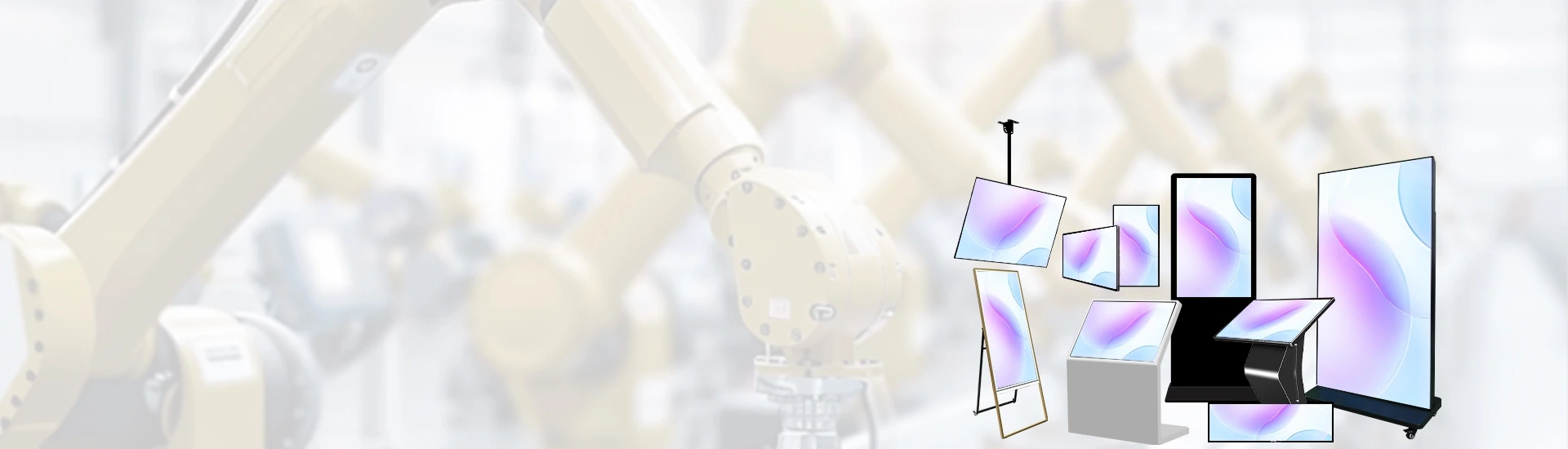
Digital Signage & Self-Ordering Kiosk Solutions for Self-Service and Buffet Restaurants
A practical deployment guide to wall-mounted digital signage, standing digital signage, self-ordering kiosks and weight-based payment kiosks for hotel buffets, buffet restaurant chains and self-service dining operators planning a multi-location hardware rollout.
Buffet and self-service restaurants run on a physical layout that most standard restaurant technology was never designed around: guests move through an open floor rather than sitting at a fixed table, food is displayed rather than delivered, and checkout has to handle pricing models a normal POS counter never sees. As self-service restaurant digital signage becomes standard infrastructure rather than a nice-to-have, procurement teams at hotel groups and restaurant chains are increasingly asking a more specific question than "what digital menu board should we buy" — they want to know exactly which hardware belongs at which point in the guest journey, how it should be specified, and which supplier can actually deliver it consistently across ten, fifty, or two hundred locations. This guide answers that question in the order a buyer needs it: the operational problem, the hardware mapped to each part of the floor, the difference between sourcing for a hotel group and sourcing for a franchise chain, and what to check before signing off on a supplier.
Self-service and buffet-style dining runs on a fundamentally different operating model than a table-service or quick-service restaurant, and the problems that come with it rarely get solved by simply hanging a screen on the wall. Four issues show up consistently across hotel buffets, cafeteria-style dining and independent buffet chains, and they compound each other during peak hours.
Peak-hour crowding builds at popular stations while staff are too slow to notice and refill depleted trays before guests are already frustrated and forming a bottleneck around the emptiest dish.
Mixed pricing models — pay-by-weight, fixed-price buffet, à la carte add-ons and drink packages — slow down manual checkout and increase cashier error rates during the exact hours when speed matters most.
Menus, allergen labels and pricing drift out of sync across multiple locations, creating both a guest-safety exposure and a brand-consistency problem that headquarters only discovers during an audit.
Front-of-house staff are pulled between answering repetitive menu questions, monitoring buffet stock levels and processing payment, leaving fewer hands for the guest-facing service that actually differentiates a premium buffet experience.
The rest of this guide maps digital signage and self-ordering kiosk hardware to each of these problems in the order a guest actually experiences them — entrance, buffet line, checkout, and the back-of-house replenishment loop that keeps the whole line running — then breaks out how sourcing priorities differ for a hotel buffet versus an independent buffet restaurant chain.
Rather than listing products by category, this section follows the physical path a guest takes through a self-service restaurant. At each stop, we name the specific product type that belongs there, what problem it solves, and the specification range worth asking a supplier about.
The entrance is where an operator can get ahead of congestion instead of reacting to it. A floor-standing digital signage unit — sometimes called standing digital signage or a digital totem — is the right form factor here because it doesn't require wall space, can be repositioned as the floor plan changes for different meal periods, and is tall enough to be read from across a lobby or waiting area.
Spec guidance: 43–65" floor-standing digital signage, 350–500 nits for indoor lobby lighting, Android or Windows media player, built-in CMS for centrally scheduled content, and a stable weighted or bolt-down base suitable for high foot-traffic areas.
Standing Digital Signage / Digital Totem — a floor-standing display built for lobbies, entrances and queue-guidance zones, with remote CMS content management so headquarters can update entrance promotions across every property from one dashboard.
Above the buffet line, a wall-mounted digital signage panel is the more practical choice than a floor unit — it stays out of the traffic flow directly in front of the food stations and can be fixed at eye level above each section (hot dishes, cold dishes, dessert, beverage) without taking up counter space that's needed for trays and serving equipment. As a buffet digital menu board, its job goes beyond looking attractive: it carries information the operator is legally and operationally responsible for getting right.
Spec guidance: 32–65" wall-mounted panels, 4K resolution, 178° viewing angle for guests approaching from either side of the station, 24/7 duty-rated components, and an anti-grease, anti-humidity housing suitable for direct placement above hot or cold food stations.
Vægmonteret digital signal — a slim-profile, wall-fixed commercial display built for retail and food-service environments, supporting remote CMS updates so every buffet station across a hotel group or chain can be refreshed centrally in real time.
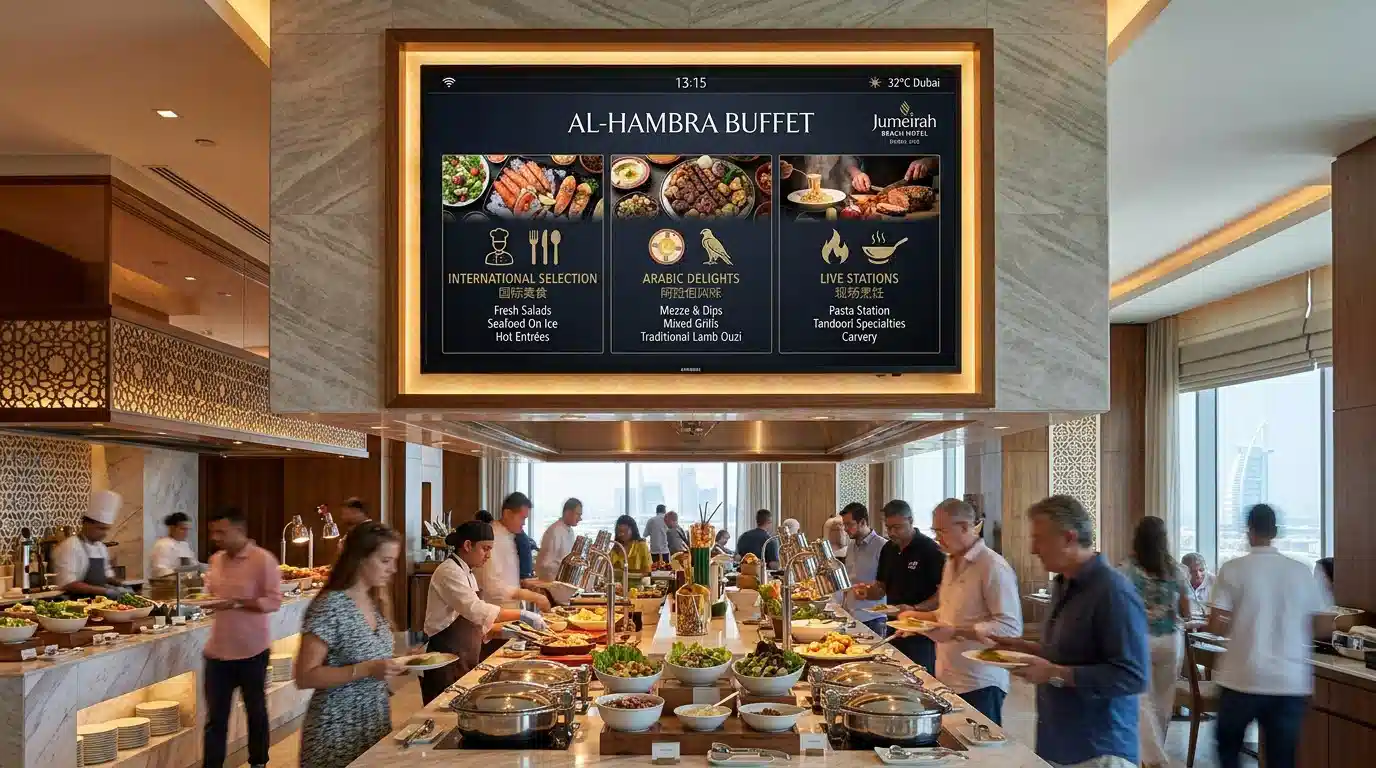
Wall-mounted digital signage installed above a hotel buffet line, displaying live menu and allergen information.
This is the point where buffet and self-service formats genuinely diverge from a standard restaurant checkout, and it's the area most buyers underspecify because the two pricing models — fixed price and pay-by-weight — need two different pieces of hardware.
For hotel buffets and all-you-can-eat formats where guests pay a single flat rate, a self-ordering kiosk — often called a payment order kiosk — handles the full transaction: selecting a meal package, adding drink upgrades or à la carte extras, and completing payment without a cashier. Positioned at the entrance or exit of the buffet area, it also doubles as a self-check-in point for hotel breakfast programs tied to a room number or loyalty account.
Self-Ordering & Payment Kiosk — a floor-standing or countertop touch kiosk supporting card, NFC and QR payment, built for fast, self-service transactions in restaurants, hospitality and retail environments.
Salad bars, weight-based buffets and mixed hot/cold self-service counters need a different tool: a desktop payment kiosk with an integrated weighing scale. The guest places their plate on the built-in scale, the unit calculates the price per item automatically, and the transaction is completed on the same countertop terminal — removing the manual weigh-and-key-in step that slows down a staffed register and introduces pricing errors.
Desktop Payment Kiosk with Weighing Scale — a countertop self-checkout terminal with a certified-accuracy integrated scale, designed for pay-by-weight buffet, salad bar and cafeteria checkout counters.
Many operators run both models side by side — a fixed-price self-ordering kiosk for the main buffet package and a weight-based kiosk for an add-on salad or dessert bar — which is worth flagging to your supplier early, since it affects POS integration and reporting setup.
Spec guidance: 15.6–32" industrial touch displays, certified scale accuracy for the weighing module, POS and payment-gateway integration (NFC, QR, card, contactless), and multi-currency, multi-payment-method compliance for chains operating across borders.
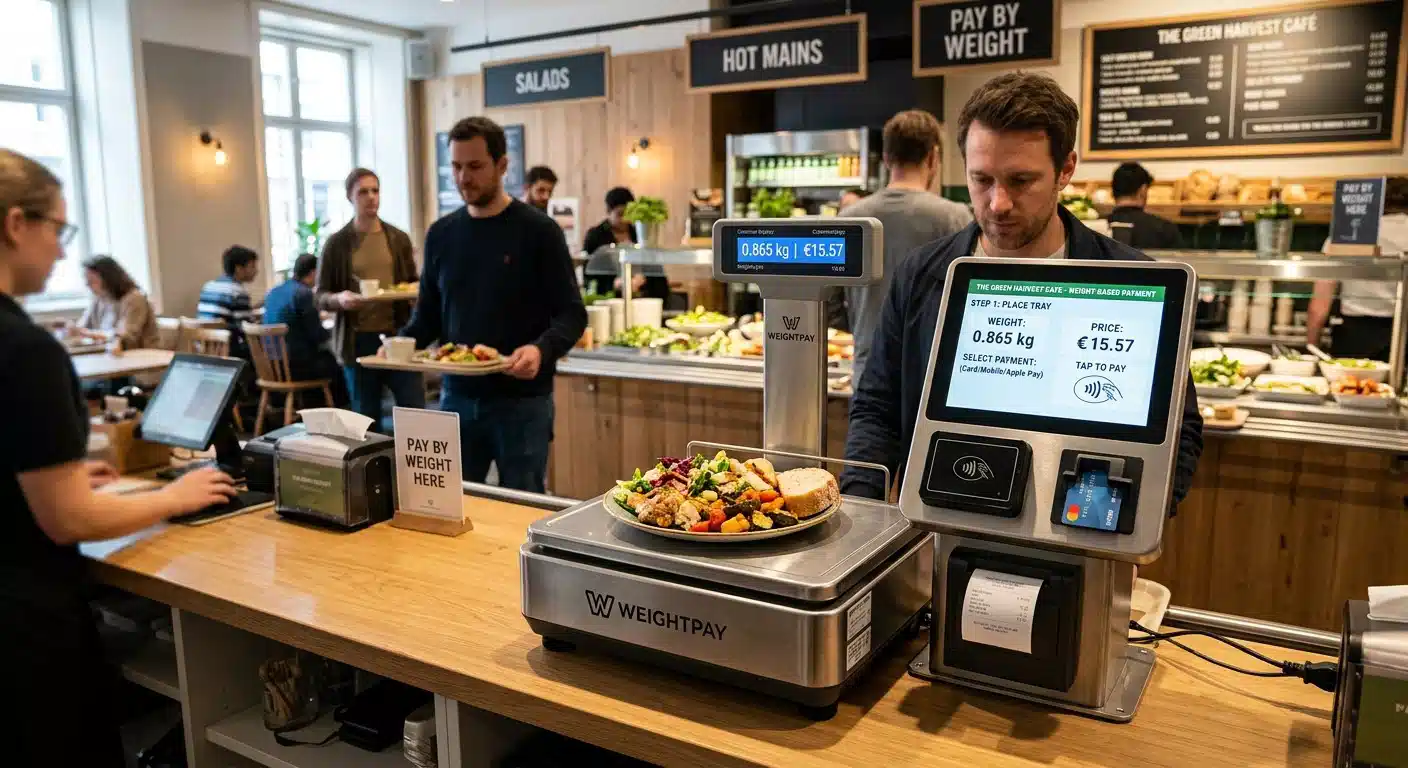
A self-ordering kiosk paired with a desktop weight-based payment kiosk at a buffet restaurant checkout counter.
This is the section operators care about most and suppliers talk about least. Back-of-house terminals should close the loop with the buffet-line display rather than showing a generic, disconnected kitchen task list.
Spec guidance: IP65-rated touch terminals, high-temperature tolerant components, continuous 24/7 duty rating, and a simple interface staff can use without training beyond a single shift.
A hotel buffet and an independent buffet chain are buying the same category of self-service restaurant digital signage for very different reasons, with different people signing off on the purchase order. A hotel group typically evaluates hardware as part of a broader property-management and guest-experience upgrade, where integration with existing hotel systems and finish quality matter as much as unit cost. An independent buffet chain, by contrast, is usually optimizing for one thing above all else: the ability to open a new location and have it look, run and report identically to every other location in the network, often on a tighter per-unit budget spread across many more screens. Recognizing which profile you're closer to changes what to prioritize in a supplier conversation.
| Hotel Group Buffet | Independent Buffet Chain | |
|---|---|---|
| Decision path | Group IT + F&B director sign-off, often coordinated across multiple properties and brand tiers | Brand headquarters sets the hardware standard; franchisees or regional managers execute locally |
| Core requirement | Integration with existing PMS/hotel systems, room-charge billing, and brand visual standards | Standardized, repeatable rollout that new locations can copy quickly with minimal on-site customization |
| Hardware priority | Display finish and quality consistent with the property's brand tier and interior design | Cost control and firmware/hardware consistency across large batch orders |
| Rollout pace | Phased across an existing portfolio of properties, often tied to renovation cycles | Tied to the new-store opening schedule; speed of deployment and supplier lead time matter most |
| Typical hardware mix | Wall-mounted digital signage plus self-ordering kiosk for room-charge and card payment | Standing digital signage at entry, wall-mounted signage on the line, and a mix of self-ordering and weight-based kiosks at checkout |
Sourcing self-service restaurant digital signage for a multi-location rollout is rarely a single transaction — it's a relationship that runs from the first layout consultation through years of firmware updates and spare-parts support. As a digital signage manufacturer operating factory-direct production lines, Qtenboard supports the full lifecycle of a buffet or hotel deployment:
Our team reviews your floor plan and buffet layout to recommend which hardware — standing digital signage, wall-mounted signage, self-ordering kiosk or weight-based kiosk — fits each zone, along with sample specifications and reference pricing before you commit to a pilot.
As a factory-direct OEM/ODM digital signage manufacturer, we customize enclosure color, screen size, mounting bracket, logo placement, and CMS software branding to match your property or franchise standard, without going through a third-party integrator.
Our production facility runs sample testing, pilot-batch verification and full-batch quality control before shipment, so the first ten units and the two-hundredth unit in a chain-wide order perform identically.
Hardware is available with CE, FCC and RoHS certification and can be configured to meet region-specific payment and electrical compliance requirements for cross-border hotel groups and restaurant chains.
We coordinate factory-to-site logistics for both single-property orders and phased, multi-location rollouts, with batch scheduling that lines up with your renovation or new-store opening timeline.
Ongoing spare-parts availability, remote troubleshooting, and CMS software support are included after installation, so hardware upgrades across existing locations can be planned in phases rather than as an all-at-once replacement.
Before committing to a pilot, most operators are effectively vetting a digital signage manufacturer's ability to deliver the same hardware, at the same quality, hundreds of times over. Use this checklist as a starting point for that conversation.
Background: A five-star hotel group operating multiple beachfront and downtown properties in Dubai runs a high-volume breakfast buffet and a themed dinner buffet across its flagship property, serving international guests with widely varying dietary requirements throughout the year.
Challenge: Breakfast service faced heavy staff pressure during a tight peak window between 7:30 and 9:30 AM, with guests repeatedly asking staff to identify allergens and confirm which dishes were vegetarian, halal or dairy-free. Menu changes tied to seasonal ingredients meant printed table cards had to be reprinted several times a week, and dinner buffet themes rotated nightly, making static signage impossible to keep current. The front desk team also fielded frequent questions about buffet timing and pricing that pulled attention away from check-in service.
Deployment: The hotel installed wall-mounted digital signage above each buffet station (hot dishes, cold dishes, dessert, and a dedicated allergen-labeled section), a standing digital signage unit at the restaurant entrance for queue guidance and daily theme announcements, and self-ordering kiosks near the exit for guests on a room-charge dining plan to confirm their package and any add-on charges without waiting for a server.
With allergen and dietary information displayed directly above each station, front-of-house staff reported a noticeable drop in repetitive guest questions during the breakfast rush, freeing them to focus on table service and special requests. Kitchen and F&B management could update dinner buffet themes and pricing centrally through the CMS the same day a menu changed, rather than waiting on a print cycle, and the standing signage at the entrance measurably smoothed guest flow into the restaurant during the tightest 30-minute window of breakfast service.
Background: A mid-sized buffet restaurant brand operating across several Italian cities was expanding into two new regions, with a mix of company-owned and franchised locations. Each new location needed to open with a consistent guest experience, since the brand's marketing centered on a fixed-price, all-you-can-eat format supplemented by a pay-by-weight salad and antipasti bar.
Challenge: Headquarters needed centralized control over menu content and pricing while keeping every location visually consistent with the brand, but new-store openings were being slowed down by manually configuring signage and checkout hardware on-site for each location. The chain also needed two different checkout flows working side by side — fixed-price for the main buffet and pay-by-weight for the salad bar — without creating confusion at the register or duplicate POS reporting.
Deployment: Every location received matching wall-mounted digital signage across the buffet line, a self-ordering kiosk for the fixed-price package, and a desktop weight-based payment kiosk at the salad and antipasti counter, all pre-configured with the brand's CMS template before shipment so each new store could be installed and switched on with minimal on-site setup.
Because hardware and CMS templates arrived pre-configured, new-store teams spent far less time on manual signage and kiosk setup, shortening the window between handover and opening day. Headquarters gained a single dashboard to push menu and pricing updates across every location simultaneously, and running the fixed-price and pay-by-weight checkout flows on separate, purpose-built kiosks eliminated the register confusion that had slowed down early locations, giving the brand a repeatable playbook for the rest of its regional expansion.
Standing digital signage, wall-mounted digital signage, self-ordering kiosks and weight-based payment kiosks covering entrance to checkout, all from one digital signage manufacturer.
Size, enclosure design, mounting method and CMS interface configuration adapted to your buffet layout and brand standard.
In-house manufacturing and quality control support pilot testing, batch production and global logistics for phased or full-scale rollouts.
Standardized firmware and hardware batches so every location, from a single hotel to a national chain, runs the same guest experience.
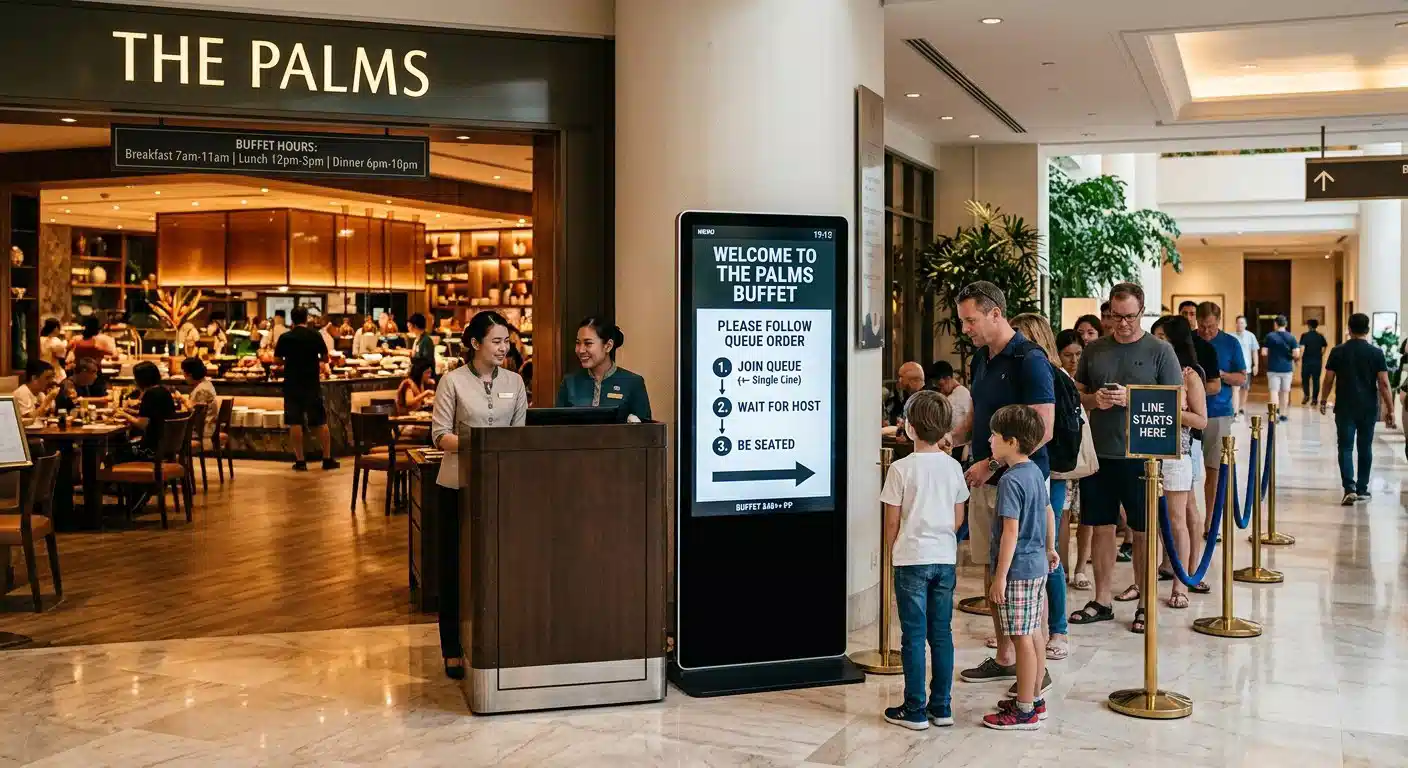
Standing digital signage deployed at a hotel buffet restaurant entrance to manage guest queue flow during peak hours.
Yes — the scale module can be configured to feed weight data directly into most commercial POS systems; confirm your specific POS API or integration protocol during the quotation stage so the correct interface is included in the build.
Can we run both a self-ordering kiosk and a weight-based kiosk in the same buffet?
Yes — this is common for buffets that combine a fixed-price main package with a pay-by-weight salad or dessert bar. Each kiosk type handles its own pricing logic, and both can report into the same back-end sales dashboard.
How is payment compliance handled across different countries?
Hardware can be configured with region-specific payment modules (NFC, QR, card readers) and supporting certifications such as CE and FCC; share your target markets so the correct configuration can be confirmed upfront.
What is the standard MOQ and lead time for a multi-location order?
This depends on the hardware mix and level of customization — request a quote with your store count and timeline through our contact page for an accurate figure.
Can we upgrade existing locations in phases rather than all at once?
Yes — phased rollouts are common for both hotel groups and chains; hardware and firmware are kept consistent across phases so early and later locations run the same experience.
What information should we provide when requesting a quotation?
Number of locations, installation positions (entrance, buffet line, checkout), preferred screen sizes, checkout model (fixed-price, pay-by-weight or both), payment methods, and delivery region.
Digitizing a self-service restaurant isn't just adding screens — it's connecting entrance signage, buffet-line displays, fixed-price or weight-based checkout, and kitchen replenishment into one operating system you can repeat across every location. As a factory-direct digital signage manufacturer, Qtenboard can walk your team through hardware selection, OEM customization and rollout planning for your next property or store.
Contact Qtenboard for a Custom QuoteTell us your location count, layout and checkout model — we'll recommend the right hardware mix and timeline.

 DAN
DAN
 EN
EN  AR
AR  IT
IT  ARM
ARM  FIN
FIN  SWE
SWE  NOR
NOR  MAY
MAY  NL
NL  TH
TH  KOR
KOR  PL
PL  JP
JP  RU
RU  PT
PT  SPA
SPA  FRA
FRA  DE
DE  CHT
CHT 